
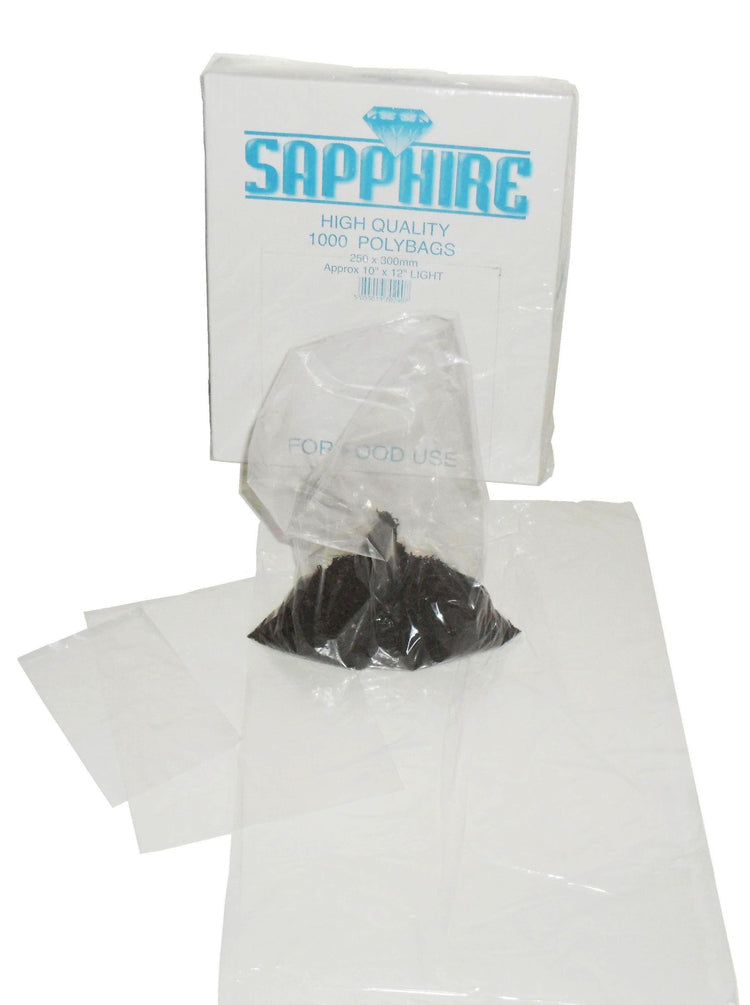
Polythene bags - Light (80-100guage) - List
-
10x12 - 100g Clear Poly Bags (254x305mm - 25mu)Regular price From £20.42 GBPRegular priceUnit price per
-
10x12 - Light Clear Poly Bags (254x305mm)Regular price From £18.29 GBPRegular priceUnit price per
-
10x15 - 100g Clear Poly Bags (254x381mm)Regular price From £25.36 GBPRegular priceUnit price per
-
10x15 - 100g Clear Poly Bags - PERFORATED (254x381mm - 25mu)Regular price From £29.97 GBPRegular priceUnit price per
-
10x15 - Light Clear Poly Bags (254x381mm)Regular price From £23.02 GBPRegular priceUnit price per
-
12x15 - 100g Clear Poly Bags (305x381mm)Regular price From £30.79 GBPRegular priceUnit price per
-
12x15 - Light Clear Poly Bags (305x381mm)Regular price From £26.52 GBPRegular priceUnit price per
-
12x18 - 100g Clear Poly Bags (305x457mm - 25mu)Regular price From £36.31 GBPRegular priceUnit price per
-
12x18 - Light Clear Poly Bags (305x457mm)Regular price From £31.14 GBPRegular priceUnit price per
-
12x20 - 100g Poly Bags (300x500mm - 25mu) - Paper WrappedRegular price From £105.20 GBPRegular priceUnit price per
-
12x20 - Light Clear Poly Bags (305x508mm)Regular price From £61.58 GBPRegular priceUnit price per
-
14x18 - 100g Clear Poly Bags (356x457mm - 25mu)Regular price From £41.82 GBPRegular priceUnit price per
-
14x24 - Light Clear Poly Bags (356x610mm)Regular price From £2.34 GBPRegular priceUnit price per
-
15x20 - 100g Clear Poly Bags (381x508mm)Regular price From £49.02 GBPRegular priceUnit price per
-
15x20 - Light Clear Poly Bags (381x508mm)Regular price From £46.83 GBPRegular priceUnit price per
-
18x24 - 100g Clear Poly Bags (457x610mm - 25mu)Regular price From £35.97 GBPRegular priceUnit price per
-
18x24 - Light Clear Poly Bags (457x610mm)Regular price From £33.42 GBPRegular priceUnit price per
-
20x22 - 100g Clear Poly Bags (508x559mm - 25mu)Regular price From £36.60 GBPRegular priceUnit price per
-
20x30 - 100g Clear Poly Bags (508x762mm)Regular price From £49.02 GBPRegular priceUnit price per
-
20x30 - Light Clear Poly Bags (508x762mm)Regular price From £39.75 GBPRegular priceUnit price per
-
24x24 - Light Clear Poly Bags (610x610mm)Regular price From £72.66 GBPRegular priceUnit price per
-
24x30 - Light Clear Poly Bags (610x762mm)Regular price From £5.01 GBPRegular priceUnit price per
-
24x36 - 100g Clear Poly Bags (610x914mm)Regular price From £68.56 GBPRegular priceUnit price per
-
24x36 - Light Clear Poly Bags (610x914mm)Regular price From £62.88 GBPRegular priceUnit price per
-
3x14 - Light Clear Poly Bags (76x356mm)Regular price From £5.88 GBPRegular priceUnit price per
-
4x6 - 100g Clear Poly Bags (102x152mm)Regular price From £4.87 GBPRegular priceUnit price per
-
4x6 - Light Clear Poly Bags (102x152mm)Regular price From £6.20 GBPRegular priceUnit price per
-
5x7 - 100g Clear Poly Bags (127x178mm)Regular price From £6.54 GBPRegular priceUnit price per
-
5x7 - Light Clear Poly Bags (127x178mm)Regular price From £7.43 GBPRegular priceUnit price per
-
6x10x18 - Clear Poly BagsRegular price From £33.97 GBPRegular priceUnit price per
-
6x12x18 - 100g Clear Poly Bags (152x305mm)Regular price From £35.97 GBPRegular priceUnit price per
-
6x15 - Light Clear Poly Bags (152x381mm)Regular price From £12.39 GBPRegular priceUnit price per
-
6x18 - Light Clear Poly Bags (152x457mm)Regular price From £0.76 GBPRegular priceUnit price per
-
6x8 - 100g Clear Poly Bags (152x203mm)Regular price From £8.70 GBPRegular priceUnit price per
-
6x8 - Light Clear Poly Bags (152x203mm)Regular price From £7.35 GBPRegular priceUnit price per
-
6x9x12 - Light Clear Poly Bags~Regular price From £9.87 GBPRegular priceUnit price per


* Many of our poly bags are suitable for food use, however there may be exceptions and if you specifically require this then it is best to get specific confirmation of this.
| Order Code | Size (Inches) | Size (mm) | Pack Quantity |
| 04L01 | 3 x 14 | 75 x 350 | 1000 |
| 04L25 | 3 x 18 | 150 x 450 | 1000 |
| 04L02 | 4 x 6 | 100 x 150 | 1000 |
| 04L03 | 6 x 8 | 150 x 200 | 1000 |
| 04L05 | 6 x 15 | 150 x 375 | 1000 |
| 04L06 | 7 x 9 | 175 x 225 | 1000 |
| 04L07 | 8 x 10 | 200 x 250 | 1000 |
| 04L08 | 8 x 12 | 200 x 300 | 1000 |
| 04L09 | 9 x 12 | 225 x 300 | 1000 |
| 04L11 | 10 x 12 | 250 x 300 | 1000 |
| 04L12 | 10 x 15 | 250 x 375 | 1000 |
| 04L13 | 12 x 15 | 300 x 375 | 1000 |
| 04L14 | 12 x 18 | 300 x 450 | 1000 |
| 04L15 | 12 x 24 | 300 x 600 | 1000 |
| 04L16 | 14 x 18 | 350 x 450 | 1000 |
| 04L24 | 14 x 24 | 350 x 600 | 1000 |
| 04L17 | 15 x 20 | 375 x 500 | 1000 |
| 04L18 | 18 x 24 | 450 x 600 | 500 |
| 04L19 | 20 x 30 | 500 x 750 | 500 |
| 04L21 | 24 x 24 | 600 x 600 | 500 |
| 04L22 | 24 x 30 | 600 x 760 | 500 |
| 04L23 | 24 x 36 | 600 x 900 | 500 |
| 04L96 | 8 x 12 x 22 | 200 x 300 x 560 | 1000 |
Polythene Bags (Light Duty 80–100 Gauge) — Overview
Light-duty polythene bags (often described as 80–100 gauge) are a versatile, everyday packaging option for protecting, grouping, and presenting products. This thickness range is commonly chosen when you need a clear, flexible bag that offers basic protection from dust and handling while keeping pack weight and material use low. Many applications include parts and components, stationery, small retail items, printed materials, and general storage.
On this page you’ll find a range of sizes in both inches and millimetres, with pack quantities shown for each line item. Selecting the right size and thickness helps reduce waste, improves packing speed, and ensures the contents are protected without using an oversized bag.
Polythene Bags (Light Duty 80–100 Gauge) — Helpful Guide
1) What “light duty” means in practice
“Light duty” typically refers to bags suited to lighter products with minimal sharp edges. They are commonly used for:
- Protection from dust and light scuffing during storage and handling
- Grouping multiple items (e.g., kits, sets, small components)
- Simple presentation where visibility of the contents is important
If your products are heavy, have sharp corners, or will be handled repeatedly in transit, you may need a thicker grade. For many day-to-day packing tasks, however, 80–100 gauge is a practical balance of clarity, flexibility, and cost efficiency.
2) Understanding gauge, microns, and thickness
Polythene bag thickness is often specified using “gauge” (a traditional measure) or microns (µm). In many packaging contexts, 80 gauge is commonly treated as approximately 20 microns, and 100 gauge as approximately 25 microns. This helps when comparing specifications across suppliers or matching an existing bag you already use.
Because terminology can vary by region and industry, the most reliable approach is to compare like-for-like thickness specifications and then validate performance with a small trial pack—especially if your product has edges, weight, or friction that could stress the film.
3) Types of packaging in this category
This collection focuses on flat, open-top polythene bags in a light-duty thickness range. They are typically used as inner packaging, protective sleeves, or simple storage bags.
4) Products available in this collection (with internal links)
The items below are the specific bag sizes listed in this collection. Use these as a quick reference when you already know the approximate width and length you need.
- 04L01 — 3 x 14 in (75 x 350 mm). A narrow, long bag format often used for slim items, strips, or elongated components.
- 04L25 — 3 x 18 in (150 x 450 mm). Extra length for longer items where a narrow opening is preferred.
- 04L02 — 4 x 6 in (100 x 150 mm). A compact general-purpose size for small parts, samples, and accessories.
- 04L03 — 6 x 8 in (150 x 200 mm). A common mid-size option for small boxed items, bundles, or printed materials.
- 04L05 — 6 x 15 in (150 x 375 mm). A longer mid-width bag for items that need extra length without increasing width.
- 04L06 — 7 x 9 in (175 x 225 mm). Useful when you need slightly more width than 6-inch formats for bulkier contents.
- 04L07 — 8 x 10 in (200 x 250 mm). A versatile size for general packing, grouping, and storage.
Note: The table on this page remains the best source for the full list of order codes, sizes, and pack quantities. Use the list above as a quick “what’s what” guide when comparing formats.
Case Study: Reducing waste by right-sizing light-duty poly bags
A small assembly operation was using a single “one-size-fits-most” bag for multiple component kits. The result was excess empty space, more film used per pack, and slower packing because operators had to fold and tape the surplus length. By switching to two right-sized light-duty bag formats—one compact size for small kits and one longer format for elongated components—the team reduced film usage per packed unit and improved packing consistency. The key change was measuring the product bundle (including any paperwork) and selecting a bag that allowed a small clearance rather than a large overhang.
How to choose the correct polythene bag
Step 1: Measure the product correctly
Measure the width and length of the item (or bundle) you want to bag. If the contents are not flat, measure the widest point and consider the thickness of the product. For bulky items, you may need additional width to accommodate the “wrap” around the product.
- Width: measure the widest face of the product.
- Length: measure the longest dimension, then add allowance for closure (fold-over, tape, label, or heat seal if applicable).
Step 2: Allow for clearance and closure
As a practical rule, add a small clearance so the product slides in easily without stretching the film. Then add extra length if you plan to fold the top over, apply a label, or create a neat presentation. Too little allowance can slow packing and increase the risk of tearing; too much allowance increases material use and can look untidy.
Step 3: Match thickness to handling conditions
Choose light duty when the bag is primarily for cleanliness and light protection. If the bag will be used as an outer pack, handled repeatedly, or exposed to abrasion, consider whether a thicker film is needed. Also consider the product’s edges—sharp corners can puncture thin film even when the product is not heavy.
Step 4: Consider clarity and presentation
Clear polythene bags are often selected because they allow quick identification of contents without opening the pack. This can reduce picking errors and speed up inventory checks. If your process relies on scanning labels, ensure there is a smooth area for label placement and that the bag size provides a consistent surface.
Step 5: Check suitability for food contact (when required)
Some polythene bags are suitable for food use, but there can be exceptions depending on material specification and intended use. If you specifically require food-contact suitability, confirm the relevant compliance information for the exact bag you plan to use and the conditions of use (e.g., direct contact, temperature, and type of food).
Common applications for light-duty polythene bags
- Parts and components: keeping small items together and reducing loss.
- Printed materials: protecting leaflets, manuals, and inserts from dust and handling.
- Retail and e-commerce: inner protection for items packed inside a box or mailing bag.
- Work-in-progress storage: separating batches, variants, or stages of assembly.
- General organisation: tidy storage for tools, accessories, and consumables.
Handling, storage, and packing tips
Preventing tears and punctures
Even with light-duty film, careful handling can significantly reduce damage. Avoid dragging bags across rough surfaces, and keep sharp-edged items from contacting the film directly. If punctures occur, consider adding a protective wrap around the product or moving to a thicker bag.
Improving packing speed
Right-sizing is one of the simplest ways to speed up packing. Bags that are too narrow slow insertion; bags that are too long require extra folding and taping. Keeping two or three commonly used sizes at the packing station often improves consistency and reduces operator decision time.
Labelling and identification
If you label bags, choose a size that provides a flat area for consistent label placement. For barcodes, ensure the label is applied smoothly without wrinkles. If you include paperwork inside the bag, place it so key information remains visible and doesn’t obscure the product.
Frequently Asked Questions (Q&A)
What does 80–100 gauge mean for polythene bag thickness?
Gauge is a traditional thickness measure for plastic film. In many packaging contexts, 80 gauge is commonly treated as about 20 microns and 100 gauge as about 25 microns. This range is generally considered light duty, suitable for lighter items and basic protection.
How do I choose the right bag size for my product?
Measure the product’s widest point for width and its longest dimension for length. Add a small clearance so the item slides in easily, then add extra length if you need a fold-over, label area, or closure. Avoid excessive oversizing to reduce waste.
Are light-duty polythene bags suitable for sharp or heavy items?
Light-duty bags are best for items without sharp edges and with modest weight. Sharp corners can puncture thin film, and heavy items can stretch or tear it during handling. If damage occurs, consider a thicker bag or add protective wrapping around the product.
Can these polythene bags be used for food products?
Some polythene bags are suitable for food contact, but suitability depends on the specific material specification and intended conditions of use. If you require food-contact compliance, confirm it for the exact bag you plan to use, including temperature and direct-contact requirements.
What’s the difference between gauge and microns when comparing bags?
Microns (µm) are a metric thickness unit, while gauge is a legacy unit used in some packaging markets. Conversions are often used to compare products across suppliers, but terminology can vary. When possible, compare microns directly and validate performance with a trial pack.