
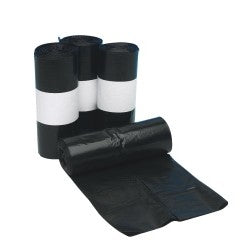
Bags / Sacks / Refuse-On-Roll
-
18x29x39 - 140g JUMBO 10 Refuse on RollRegular price From £2.93 GBPRegular priceUnit price per
-
28x34 - 62g MAMMOTH Refuse on RollRegular price From £0.22 GBPRegular priceUnit price per
-
18x29x34 - 140g WORTHMINSTER 25 Refuse on RollRegular price From £117.53 GBPRegular priceUnit price per
-
18x28x34 - 20mu H.T "STRONG" Refuse SacksRegular price From £0.55 GBPRegular priceUnit price per
-
18x29x39 - 120g Refuse on RollRegular price From £0.62 GBPRegular priceUnit price per


Refuse-on-roll is a convenient way to store and dispense refuse sacks. They come in a roll, similar to toilet paper, making it easy to tear off a bag as needed. This eliminates the need for bulky boxes or individual bags, saving space and reducing clutter.
Bags / Sacks / Refuse-On-Roll
| Order Code | Description | Size (Inches) | Size (mm) | Thickness (guage) |
| 09R410 | Heavy 10's Refuse on Roll | 18 x 29 x 34 | 450 x 725 x 865 | 140 |
| 09T910 | Eagle' Refuse on Roll | 18 x 29 x 39 | 450 x 725 x 975 | 140 |
| 09R425 | Finch' Refuse on Roll | 18 x 29 x 34 | 450 x 725 x 865 | 140 |
| 09R410L | Refuse on Roll | 18 x 29 x 34 | 450 x 725 x 865 | 92 |
Refuse-on-roll sacks are designed for fast, tidy dispensing in busy environments. Instead of handling loose bags from a box, you pull the next sack from the roll and tear it off at the perforation. This simple format helps keep storage areas organised, reduces handling time, and makes it easier to standardise waste-liner use across teams and shifts.
Bags / Sacks / Refuse-On-Roll — Helpful Guide
This category focuses on heavy-duty refuse sacks supplied on rolls. The products listed here share a common purpose—lining bins and containing general waste—while differing by size and thickness (gauge). Use the guide below to match the right sack to your bin size, waste type, and handling conditions.
Types of refuse-on-roll sacks in this category
-
Heavy-duty refuse-on-roll sacks (higher gauge)
Best for heavier loads, sharper edges, or when sacks are dragged or compacted. A higher gauge generally indicates a thicker film and improved puncture/tear resistance. -
Standard refuse-on-roll sacks (lower gauge)
Suitable for lighter general waste where the sack is lifted carefully and the contents are not abrasive or sharp. -
Different drop lengths for different bin heights
Even when the opening size is similar, a longer “drop” (the last dimension) can help the liner fold over the rim and stay in place, especially on taller bins.
Products available on this page (with quick-use notes)
Below are the refuse-on-roll products shown in the table on this category page. Use these links to jump to the product pages for ordering details and pack formats.
-
Heavy 10's Refuse on Roll
Heavy-duty refuse-on-roll option in an 18 x 29 x 34 inch format. A practical choice for general waste where extra strength is needed for day-to-day handling. -
Eagle' Refuse on Roll
Heavy-duty refuse-on-roll option in an 18 x 29 x 39 inch format. The longer drop can suit taller bins or situations where you want more liner to fold over the rim. -
Finch' Refuse on Roll
Heavy-duty refuse-on-roll option in an 18 x 29 x 34 inch format. Useful where you want a strong liner for routine waste streams. -
Refuse on Roll
Refuse-on-roll option in an 18 x 29 x 34 inch format with a lower gauge than the heavy versions. Suitable for lighter waste where a thinner liner is acceptable.
Case study: reducing liner waste and improving consistency
A facilities team managing multiple washrooms and kitchenettes often faces two recurring issues: (1) inconsistent liner sizes being used across locations, and (2) over-specification—using very heavy liners everywhere “just in case.” By standardising on a small set of refuse-on-roll sizes and gauges, the team can simplify replenishment and reduce errors.
In practice, the team first identifies the most common bin sizes on site and then assigns a liner specification to each bin type. For example, a standard office bin may only need a lighter-gauge liner, while a kitchen waste bin may require a heavier-gauge liner due to wet waste, heavier loads, and more frequent handling. Because refuse-on-roll sacks dispense one at a time, staff can quickly grab the correct liner without opening boxes or dealing with loose stacks of bags.
The result is typically fewer split sacks, fewer double-bagging habits, and less time spent searching for the right liner. Standardisation also makes it easier to train new staff and to keep satellite storage points stocked with the correct rolls.
How to choose the correct refuse-on-roll sack
1) Confirm bin dimensions and required “drop”
Refuse sack sizing is commonly shown as three dimensions (for example, 18 x 29 x 34 inches). While naming conventions vary, the key practical checks are:
- Opening fit: The sack must comfortably fit around the bin rim without excessive stretching. If the opening is too tight, the film is stressed and more likely to tear.
- Drop/length: The sack must be long enough to reach the bottom of the bin and still allow a fold-over at the top. A longer drop can improve retention on taller bins.
- Allow for overhang: A small fold-over helps keep the liner in place and makes removal easier, especially when bins are emptied frequently.
2) Match gauge to waste type and handling
Gauge is a common way to describe film thickness. As a general rule, a higher gauge indicates a thicker film and can provide better resistance to punctures and tearing. Consider:
- Weight of waste: Heavier loads benefit from higher gauge.
- Sharp or abrasive contents: Packaging offcuts, broken items, or rigid waste can puncture thinner liners.
- Handling method: If sacks are dragged, compacted, or carried long distances, extra strength helps reduce failures.
- Wet waste: Liquids increase effective load and can stress seams; stronger liners can reduce leaks from splits.
Where possible, avoid over-specifying. Using a heavier gauge than necessary can increase material use without improving performance for light waste streams. A simple trial—testing one or two gauges in the real environment—often identifies the best balance of strength and practicality.
3) Consider dispensing and storage workflow
Refuse-on-roll sacks are particularly useful when you want controlled dispensing and tidy storage. They can be stored on shelves, in cupboards, or in wall-mounted dispensers. When planning your workflow, think about:
- Point-of-use availability: Keeping rolls near the bins reduces time spent fetching liners.
- One-at-a-time dispensing: Helps reduce accidental overuse compared with loose stacks.
- Perforation quality: Clean tearing at the perforation supports faster changes and reduces wasted bags.
4) Check compatibility with bin-liner frames and holders
Some bins use liner frames, clamps, or holders. If the liner is too short, it may slip out; if it is too tight, it may tear during fitting. A slightly longer drop can help with fold-over and retention. If you use holders, trial-fit a roll sack to confirm it seats properly and can be removed without snagging.
Common applications
- Offices and reception areas: General waste where tidy dispensing and consistent sizing are important.
- Kitchens and break rooms: Heavier, wetter waste streams that may require higher gauge.
- Washrooms: Frequent liner changes where quick tear-off and easy storage help.
- Light industrial and workshops: Where puncture resistance matters due to offcuts or rigid waste.
- Cleaning and janitorial teams: Mobile carts and storage areas benefit from compact rolls.
Handling tips to reduce splits and leaks
- Don’t overfill: Overfilling increases stress at the rim and seams and makes removal harder.
- Avoid sharp edges: If waste includes sharp items, wrap them or use a higher gauge liner.
- Lift correctly: Support the base of the sack when lifting heavy loads to reduce strain on the film.
- Keep the rim clean: Rough or damaged bin rims can snag and tear liners during fitting and removal.
- Use the right size: A liner that is too small is more likely to tear; too large can bunch and snag.
Frequently asked questions
What does “refuse-on-roll” mean, and how is it different from loose sacks?
Refuse-on-roll sacks are supplied as a continuous roll with perforations between bags. You pull and tear off one sack at a time. Compared with loose sacks in a box, rolls typically store more neatly and make dispensing faster and more controlled.
How do I choose the right sack size for my bin?
Measure the bin opening and height, then choose a sack that fits the rim comfortably and is long enough to reach the bottom with extra length to fold over the top. If the sack is too tight it may tear; too short may slip.
What does gauge mean for refuse sacks?
Gauge is a common way to indicate film thickness. In general, a higher gauge means a thicker, stronger sack with better resistance to punctures and tearing. Choose higher gauge for heavier, wetter, or sharper waste, and lower gauge for lighter general waste.
Why do bin liners split even when they seem thick enough?
Splits often come from overfilling, sharp edges inside the waste, snagging on rough bin rims, or dragging sacks during removal. Using the correct size, avoiding sharp items, and supporting the base when lifting heavy loads can reduce failures significantly.
Are longer sacks always better for taller bins?
A longer drop can help on taller bins by allowing more fold-over at the rim, improving grip and making removal easier. However, overly long liners can bunch at the bottom and snag. Aim for enough extra length to fold over without excessive surplus.