
Equipment / Stationary / Felt Pens
-
Chisel Felt Pens Black Permanent MarkersRegular price From £9.94 GBPRegular priceUnit price per
-
Bullet Felt Pens Black Permanent MarkersRegular price From £0.68 GBPRegular priceUnit price per


Equipment / Stationary / Felt Pens
Felt Pens & Markers for Clear, Consistent Marking
Felt pens and marker pens are everyday tools for writing, labeling, and organizing—whether you’re marking cartons in a packing area, writing on a whiteboard in a meeting room, or creating bold headings on signage. This category brings together several common marker styles used in workplaces and facilities: permanent markers (in multiple tip shapes), standard pens for general writing, and dry-erase whiteboard markers.
Because “marker” can describe both the ink type (permanent vs. dry-erase) and the tip shape (chisel, bullet, fine), choosing the right option is mostly about matching the surface, the required durability, and the line width you need.
Felt Pens — Helpful Guide
Use the sections below to match the marker type to your task. Where possible, product names are linked so you can quickly confirm pack sizes, tip style, and intended use.
Permanent markers (durable, long-lasting marks)
Permanent markers are designed for marks that resist smudging and are harder to remove than dry-erase inks. They’re commonly used for labeling cartons, storage bins, equipment tags, and general facility identification. Tip shape determines line width and how the marker behaves on different writing angles.
-
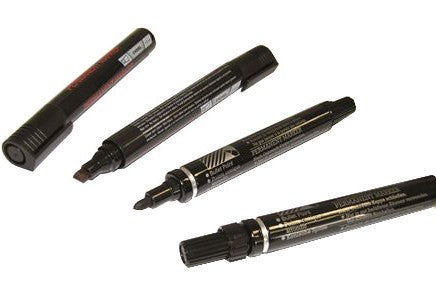
Chisel Felt Pens Black Permanent Markers
A chisel tip creates both broad strokes and thinner lines depending on angle—useful for bold carton labeling, headings, and quick sign writing where readability at a distance matters.
-
Bullet Felt Pens Black Permanent Markers
A bullet tip produces a consistent, rounded line and is easy to control for everyday labeling and general writing where you want uniform strokes.
-
Fine - Permanent Markers
A fine tip is suited to smaller labels, detailed notes, and neat handwriting—ideal when space is limited or when you need more precision than a standard marker line.
Dry-erase markers (for whiteboards and planning boards)
Whiteboard markers use dry-erase ink intended to wipe clean from compatible whiteboard surfaces. They’re best for meeting rooms, production planning boards, training areas, and temporary notes that need frequent updates.
-
White Board Marker Pens
Dry-erase marker pens for writing and quick erasing on whiteboards. Use for schedules, task lists, and visual management boards where information changes regularly.
Everyday writing pens (general office and admin use)
For routine writing on paper—forms, delivery notes, checklists, and office documentation—standard pens are often the most practical choice. They’re designed for consistent writing feel and clean lines on paper.
-
Bic Black Pens
General-purpose black pens for everyday writing tasks such as forms, notes, and administrative paperwork where a pen is preferable to a marker.
Case Study: Improving Label Legibility in a Busy Dispatch Area
A dispatch team was experiencing misreads on handwritten carton notes during peak periods. The issue wasn’t the information—it was inconsistent line thickness and low contrast on certain carton surfaces. By standardizing on a black permanent marker for carton labeling and reserving fine-tip permanent markers for small labels, the team improved legibility and reduced clarification calls. Separately, whiteboard markers were kept for planning boards only, preventing accidental use of permanent ink on wipe-clean surfaces.
How to Choose the Correct Pen or Marker
1) Start with the surface
- Paper: a standard pen is usually best for clean writing and controlled lines.
- Cardboard/cartons: permanent markers are commonly used for bold, readable labeling.
- Plastic, metal, glass: permanent markers are typically preferred when you need the mark to last (always test first on critical surfaces).
- Whiteboards: use dry-erase whiteboard markers to avoid staining and to enable easy updates.
2) Decide how permanent the mark should be
- Temporary information: choose whiteboard markers for wipe-clean notes.
- Longer-lasting identification: choose permanent markers for labels and markings that should remain in place.
3) Pick the tip shape for the line you need
- Chisel tip: flexible line width; good for bold writing, headings, and quick signage.
- Bullet tip: consistent medium line; good for general labeling and everyday marker writing.
- Fine tip: narrow line; good for small labels, detailed notes, and neat handwriting.
4) Consider workflow and storage
- Point-of-use placement: keep the right marker at the workstation where it’s used (e.g., permanent markers at packing benches; whiteboard markers at boards).
- Cap discipline: markers dry out when left uncapped—simple habits can reduce waste and interruptions.
- Color control: if you use multiple colors on boards, define what each color means (e.g., planned vs. in-progress vs. completed) to avoid confusion.
Common Mistakes (and How to Avoid Them)
- Using permanent markers on whiteboards: can stain boards and create cleanup issues. Keep dry-erase markers physically separate and clearly labeled.
- Choosing a tip that’s too broad for the label: broad tips can make small text unreadable. Use fine tips for small labels and detailed writing.
- Relying on a pen for carton labeling: pens can be hard to read on textured cardboard. A permanent marker often improves contrast and visibility.
- Not testing on the actual surface: coatings and textures vary. For critical labeling, test a small area first to confirm legibility and drying time.
Care, Handling, and Practical Tips
- Store horizontally when possible: helps ink distribute more evenly in many marker designs.
- Allow drying time: especially on glossy or non-porous surfaces to reduce smearing.
- Use appropriate cleaners: dry-erase boards typically clean with a dry cloth; stubborn residue may need a board-safe cleaner.
- Replace when lines fade: faint marks reduce readability and can cause downstream errors in picking, packing, or inventory identification.
Questions & Answers
What’s the difference between a permanent marker and a whiteboard marker?
Permanent markers are intended to leave durable marks on many surfaces and are harder to remove. Whiteboard markers use dry-erase ink designed to wipe clean from compatible whiteboards. Using permanent ink on a whiteboard can cause staining and cleanup problems.
How do I choose between chisel, bullet, and fine tips?
Choose chisel tips for bold writing and variable line widths, bullet tips for consistent everyday lines, and fine tips for small labels and detailed notes. Tip choice mainly affects line thickness and control, especially when writing quickly or in limited space.
Which marker type is best for labeling cartons and packaging?
For carton labeling, permanent markers are commonly used because they create high-contrast, longer-lasting marks on cardboard. A chisel tip helps with large, readable text, while a bullet or fine tip can suit smaller labels. Testing on your carton surface improves results.
Why do markers dry out quickly, and how can I prevent it?
Markers often dry out when left uncapped or stored in ways that let the tip lose moisture. Recap immediately after use, avoid leaving markers near heat sources, and store them consistently. If a marker is used frequently, keeping spares at the workstation reduces downtime.
Can I use the same marker for paper and non-porous surfaces like plastic?
Some permanent markers can write on both paper and non-porous surfaces, but performance varies by surface texture and coating. On plastic or metal, ink may need more drying time to avoid smearing. For critical labeling, test first to confirm legibility and durability.