
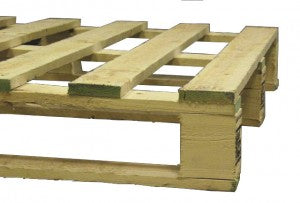
Strapping / Timber Pallets
-
Euro - Timber Pallets ( Light )Regular price From £2.49 GBPRegular priceUnit price per
-
Large - Timber PalletsRegular price From £4.97 GBPRegular priceUnit price per
-
1mx1m - Timber PalletsRegular price £0.00 GBPRegular priceUnit price per
-
Euro - Timber PalletsRegular price From £5.46 GBPRegular priceUnit price per
-
Insta-Pal corners - Plastic foot (Pallet Replacement)Regular price From £4.97 GBPRegular priceUnit price per


Heat treated, standard pallets for export and general use.
Wooden pallets for export often need to be heat treated to the international standard ISPM15.
- Choice of sizes
- Tough and strong
- Re-useable
Strapping / Timber Pallets
| Order Code | Description/Size | Size (mm) L x W | Type |
| 17TPE | Standard 4 way entry pallet | 1200 x 800 | Euro |
| 17TPL | Standard 4 way entry pallet | 1200 x 1000 | Container |
Heat Treated Timber Pallets for Export & General Distribution
Timber pallets are a widely used load base for warehousing, domestic distribution, and international shipping. In this collection you’ll find standard, re-useable wooden pallets designed for dependable handling and stacking, including common footprints used across the UK and Europe. Where shipments cross borders, wooden pallets often need to be heat treated and marked to meet international phytosanitary rules (ISPM 15) for wood packaging material.
Typical benefits of timber pallets include strong load support, compatibility with pallet trucks and forklifts, and straightforward repair or re-use in closed-loop supply chains. Selecting the right pallet size and entry style helps reduce handling time, improve trailer/container utilisation, and lower the risk of product damage in transit.
Strapping / Timber Pallets — Helpful Guide
This category focuses on standard timber pallets commonly used as a base for strapping, stretch wrapping, and general unitisation. Below is a practical guide to the pallet types and related items shown in this collection, with quick notes on where each is typically used.
1) Euro footprint pallets (1200 x 800)
-
Euro - Timber Pallets
Commonly used across Europe and the UK for retail and distribution networks. The 1200 x 800 mm footprint is a frequent choice where space efficiency and compatibility with standard racking and vehicles is important. -
Euro - Timber Pallets ( Light )
A lighter-duty option in the same Euro footprint, often chosen where loads are lower, manual handling is more frequent, or where reducing pallet tare weight is beneficial.
2) Container footprint pallets (1200 x 1000)
-
Large - Timber Pallets
A 1200 x 1000 mm pallet is commonly selected for container loading and general industrial distribution. The larger footprint can improve stability for wider cartons or sacks and can suit certain racking layouts.
3) Square pallets (1000 x 1000)
-
1mx1m - Timber Pallets
A square pallet footprint can be useful for evenly distributed loads, drums, or applications where turning and orientation flexibility is helpful in storage and picking areas.
4) Pallet replacement / alternative bases
-
Insta-Pal corners - Plastic foot (Pallet Replacement)
Corner/foot components that can be used to create a stable base under certain loads. These can be useful where a full timber pallet is not required, or where you want a compact base that still allows handling and unitisation.
Understanding Heat Treatment & ISPM 15 (Export Pallets)
Many countries require solid wood packaging material (including pallets, skids, crates, and dunnage) to comply with ISPM 15 to reduce the spread of pests. Compliance is not determined by pallet size or whether it is a 2-way or 4-way entry design; it depends on whether the pallet is made from solid wood and has been treated and marked correctly.
- Heat treatment (HT): A common ISPM 15 method where the wood is heated so the core reaches at least 56°C for a minimum of 30 minutes.
- Debarking: ISPM 15 requires wood packaging material to be made from debarked wood (with limited allowances for small pieces of bark).
- Marking: Compliant pallets are typically stamped with the official IPPC/ISPM 15 mark, including the IPPC symbol, a country code, a producer/treatment provider code, and a treatment code such as HT.
Always confirm the destination country’s import requirements for wood packaging material before shipping, as additional rules may apply depending on the route, commodity, or local regulations.
Case Study: Reducing Transit Damage on Strapped Loads
A distributor shipping boxed goods experienced recurring corner crush and strap loosening after long-haul transport. The investigation found that pallet footprint and deck support were contributing factors: cartons overhung the pallet edges, and the strap tension was concentrating on unsupported areas.
By switching to a pallet size that fully supported the carton footprint (reducing overhang), improving load alignment, and ensuring straps were applied over stable deck boards, the business reduced movement within the unit load. They also standardised a simple pre-dispatch check: pallet condition, deck integrity, and consistent strap placement. The result was fewer damaged cartons and more predictable unloading at the destination.
How to Choose the Correct Timber Pallet
Step 1: Match the pallet footprint to your load
Choose a pallet size that supports the full base of your product wherever possible. Overhang can increase damage risk and can make strapping less effective. If your cartons or sacks are close to the pallet edge, consider whether a larger footprint (e.g., 1200 x 1000) improves stability.
Step 2: Consider handling method and entry
Four-way entry pallets are commonly preferred in busy warehouses because they can be approached from all sides, improving manoeuvrability. If your operation uses pallet trucks in tight aisles, entry style and deck clearance can affect day-to-day efficiency.
Step 3: Check load weight, stacking, and racking needs
Loads that are stacked high, stored in racking, or transported over long distances typically benefit from stronger pallet construction and consistent deck support. If pallets will be re-used multiple times, durability and repairability become more important than one-trip optimisation.
Step 4: Decide whether export compliance is required
If the pallet will cross international borders and is made from solid wood, specify ISPM 15 compliance (often heat treated and marked). Keep records where needed for shipping documentation and ensure the pallet is clearly stamped.
Step 5: Plan for unitisation (strapping and wrapping)
Pallet choice and unitisation method work together. A stable pallet base helps straps maintain tension and helps stretch wrap cling evenly. Ensure the load is squared, heavy items are placed low, and the pallet deck is in good condition to avoid strap abrasion or punctures.
Best Practices for Safe Palletised Loads
- Inspect pallets before use: Avoid pallets with broken boards, protruding nails, or excessive contamination that could compromise load stability.
- Keep loads within the pallet footprint: Where possible, avoid overhang and ensure even weight distribution.
- Use edge protection when strapping: Corner/edge protectors can reduce carton damage and help straps maintain tension (especially on sharp edges).
- Control moisture exposure: Timber can absorb moisture; store pallets in a dry area where possible and avoid prolonged outdoor exposure.
- Label clearly: Apply shipping labels to flat, clean surfaces and avoid placing labels where straps or wrap will obscure scanning.
Common Sizes in This Collection (Quick Reference)
- 1200 x 800 mm: Often referred to as a Euro footprint; widely used in distribution.
- 1200 x 1000 mm: Common for container loading and industrial applications.
- 1000 x 1000 mm: Square footprint for flexible orientation and evenly distributed loads.
Q&A
Do all wooden pallets need heat treatment for export?
Not always, but many countries require solid wood packaging material to comply with ISPM 15. If your pallet is made from solid wood and will cross borders, it often must be treated (commonly heat treated) and carry the official ISPM 15 mark.
What does the ISPM 15 stamp on a pallet mean?
The stamp indicates the pallet meets ISPM 15 requirements and has been treated by an approved provider. The mark typically includes the IPPC symbol, a country code, a producer/treatment provider code, and a treatment code such as HT for heat treatment.
How do I choose between 1200 x 800 and 1200 x 1000 pallets?
Start with your product footprint and how you load vehicles or containers. A 1200 x 800 pallet can improve space efficiency in many distribution networks, while 1200 x 1000 can better support wider loads and may suit certain container or racking layouts.
What is the difference between a light pallet and a standard pallet?
Light pallets are typically designed for lower load weights or shorter handling cycles and may reduce overall shipment tare weight. Standard pallets generally provide greater robustness for heavier loads, repeated handling, stacking, or longer transport routes where durability is critical.
Are pallet replacement corners suitable for all loads?
Pallet replacement corners can work well for specific, stable loads where a full timber pallet is unnecessary. Suitability depends on load weight, base rigidity, handling method, and transport conditions. For uneven or high-risk loads, a full pallet often provides more consistent support.