
Equipment / Ropes
-
20mm - Blue Polypropylene RopeRegular price £0.00 GBPRegular priceUnit price per
-
16mm - Blue Polypropylene RopeRegular price £0.00 GBPRegular priceUnit price per
-
12mm - Blue Polypropylene RopeRegular price £0.00 GBPRegular priceUnit price per
-
8mm - Blue Polypropylene RopeRegular price £0.00 GBPRegular priceUnit price per


Equipment / Ropes
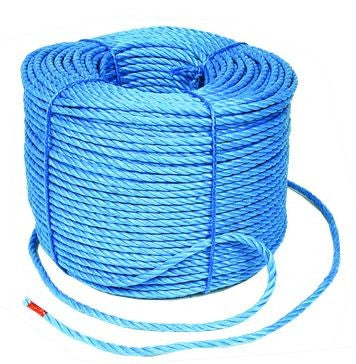
Polypropylene rope is a practical, general-purpose line used anywhere you need a lightweight, water-resistant rope that’s easy to handle. In this collection you’ll find blue polypropylene rope in four common diameters—8mm, 12mm, 16mm, and 20mm—covering everything from light tie-downs to heavier utility and marine tasks.
Equipment / Ropes — Helpful Guide
This category focuses on blue polypropylene (PP) rope. PP rope is widely used because it is lightweight and has a density lower than water, which means it floats—an advantage for many water-adjacent jobs such as marker lines, throw lines, and general dockside utility work. It also resists water absorption well, making it suitable for wet environments where natural-fiber ropes can swell or degrade faster.
Like all ropes, performance depends on diameter, construction, and how it’s used. Knots, abrasion, UV exposure, and shock loading can reduce strength significantly, so choose a size with an appropriate safety margin for your application.
Rope types in this category
-
Light-duty utility rope (smaller diameter)
Best for bundling, light tie-downs, tarps, camping, and general lashing where easy handling matters.- 8mm - Blue Polypropylene Rope — A versatile, easy-to-knot size for everyday utility tasks, light marine use, and temporary lines.
-
Medium-duty general-purpose rope
A common step up for yard, farm, workshop, and small-boat utility where you want more hand comfort and higher capacity.- 12mm - Blue Polypropylene Rope — A balanced diameter for medium tie-downs, barrier lines, and general hauling where flotation and water resistance are helpful.
-
Heavy-duty utility and dockside rope
Larger diameters are easier on the hands under load and are often chosen for heavier pulling, work lines, and more demanding outdoor use.- 16mm - Blue Polypropylene Rope — A heavier utility line suited to tougher outdoor tasks, larger barriers, and more substantial marine utility applications.
- 20mm - Blue Polypropylene Rope — A large-diameter option for heavy-duty utility work where a thicker, more comfortable line is preferred.
What polypropylene rope is (and why it’s used)
Polypropylene is a synthetic polymer commonly used in rope because it offers a useful mix of low weight, water resistance, and affordability. One of its defining properties is that it floats in water, which can be important for safety and retrieval in marine and waterside environments. Polypropylene rope is also commonly chosen for temporary lines, general-purpose hauling, and barrier/guide ropes because it is easy to handle and typically easy to splice in many constructions.
Key characteristics you can expect
- Floats — helpful for buoy lines, marker lines, and retrieval.
- Low water absorption — stays lighter in wet conditions than many alternatives.
- Good general chemical resistance — often suitable for everyday outdoor and industrial environments (application dependent).
- Limitations — typically lower abrasion resistance and strength than some other synthetics (such as nylon or polyester), and long-term UV exposure can reduce service life.
Diameter matters: how to think about 8mm vs 12mm vs 16mm vs 20mm
Rope diameter affects more than just strength. It changes how the rope feels in the hand, how it behaves around cleats and hardware, how easily it knots, and how visible it is. As a general rule, larger diameters provide higher breaking strength and are more comfortable to grip under load, while smaller diameters are lighter, easier to store, and better for quick tie-offs.
Typical use guidance by size
8mm
Often used for light tie-downs, bundling, tarps, camping, and general lashing. In marine settings it can work well as a light utility line, a simple retrieval line, or for temporary tasks where flotation is beneficial.
12mm
A common general-purpose size for medium-duty tasks. It’s frequently chosen for barrier ropes, yard and farm use, and small-boat utility lines where you want a bit more capacity and easier handling than thinner rope.
16mm
Better suited to heavier utility work and more demanding outdoor use. The thicker diameter can be easier on hands and may be preferred for dockside work lines, heavier pulling, and larger temporary barriers.
20mm
A heavy-duty diameter typically selected when you want a substantial line for demanding utility tasks and comfortable handling. It can be useful for larger barriers, work lines, and applications where visibility and grip are priorities.
Breaking strength vs safe working load (why the difference matters)
Breaking strength is the load at which a new rope fails under controlled testing. It is not the load you should routinely apply in real use. Real-world conditions—knots, bends around hardware, abrasion, shock loading, and aging—can reduce strength significantly. For that reason, many users apply a safety factor to estimate a conservative working load for general utility tasks.
As a planning guideline, general-purpose applications often use a safety factor around 5:1, while more critical uses may require higher factors. If your application involves lifting, overhead loads, or any life-safety scenario, use properly rated and certified equipment and follow applicable regulations and standards.
Practical strength expectations (planning ranges)
Exact values vary by construction and manufacturer, but typical reference tables for polypropylene-type ropes show approximate breaking-strength ranges that increase substantially with diameter. Use these only as rough planning context and verify specifications for your exact rope and application.
- 8mm: roughly in the hundreds of kilograms range (often around 700–1,000 kg in reference tables).
- 12mm: commonly around 1,500–2,100 kg in reference tables.
- 16mm: commonly around 2,700–3,600 kg in reference tables.
- 20mm: commonly around 4,200–5,600 kg in reference tables.
Remember: knots can reduce rope strength, and dynamic loads (sudden jerks) can exceed static loads quickly. When in doubt, size up and reduce shock loading by controlling starts/stops and avoiding sharp edges.
How to choose the correct rope for your job
1) Define the job: tie-down, pulling, barrier, or marine utility
Start by identifying what the rope will do most of the time. A tarp tie-down and a dockside work line are very different tasks. For simple bundling and light tie-offs, 8mm is often sufficient. For heavier pulling or frequent handling under load, 12mm–20mm may be more appropriate.
2) Consider the environment: water, sun, abrasion, and chemicals
- Water exposure: Polypropylene’s low water absorption and flotation can be beneficial.
- Sun/UV: If the rope will live outdoors, inspect it regularly and replace it when it becomes stiff, faded, or shows surface cracking/fuzzing.
- Abrasion: If the rope will rub on rough surfaces, protect it with chafe guards or route it away from sharp edges.
- Chemicals: Confirm compatibility if the rope may contact oils, solvents, or industrial chemicals.
3) Match diameter to handling and hardware
Check the size of cleats, fairleads, pulleys, and tie points. A rope that is too thick may not seat properly, while a rope that is too thin can be hard to grip and may concentrate pressure on hardware. If you’re using knots frequently, choose a diameter that ties cleanly and can be untied without excessive jamming.
4) Plan for safety margin and real-world losses
Use a conservative working load approach rather than relying on breaking strength. Account for knots, bends, wear, and shock loads. If the rope will be used repeatedly under higher loads, consider stepping up a diameter to improve durability and handling comfort.
Handling, knots, and care tips
Reducing wear and extending service life
- Avoid sharp edges: Route rope over smooth surfaces or use edge protection.
- Minimize shock loading: Apply load gradually; avoid sudden jerks.
- Inspect regularly: Look for glazing, melted spots, severe fuzzing, flat areas, or discoloration.
- Store properly: Keep rope clean, dry, and out of direct sunlight when not in use.
Knots and terminations (general guidance)
Knots are convenient but can reduce strength. For repeated use, consider consistent terminations and avoid overly tight knots that are difficult to untie. If you need a fixed loop, choose a reliable loop knot and dress it properly. For joining two ropes, use a knot suited to similar diameters and expected loading direction.
Case study: setting up a temporary waterside work zone
Imagine a small maintenance team needs to create a temporary boundary near a dock to guide foot traffic away from a wet work area. The rope must be visible, easy to handle with gloves, and tolerant of splashes. A blue polypropylene rope is a practical choice because it resists water absorption and remains easy to manage when wet.
For short spans and light tension, an 8mm line can work well and stores compactly. If the boundary will be handled frequently, needs to span longer distances, or must remain taut with less sag, stepping up to 12mm or 16mm can improve grip and reduce stretch perception under light loads. Where the rope will be grabbed repeatedly or tensioned more firmly, a thicker diameter can also reduce hand fatigue.
To improve longevity, the team routes the rope through smooth guide points, avoids dragging it across concrete edges, and inspects it daily for abrasion. When the job is complete, the rope is rinsed if needed, dried, and stored out of sunlight.
Common mistakes to avoid
- Using breaking strength as a working limit: Always apply a safety factor and account for knots and wear.
- Ignoring abrasion points: Most premature failures come from chafe on edges and rough surfaces.
- Choosing too small a diameter for frequent handling: Thin rope can be hard on hands and may be harder to control under load.
- Using general-purpose rope for lifting or life-safety: Use certified, application-specific equipment for those scenarios.
Questions & Answers
Does polypropylene rope float, and why does that matter?
Yes. Polypropylene has a density lower than water, so it typically floats. This helps for marker lines, retrieval lines, and waterside utility tasks because the rope is easier to see and recover, and it’s less likely to snag underwater.
How do I choose between 8mm, 12mm, 16mm, and 20mm rope?
Choose based on load, handling comfort, and hardware fit. Smaller diameters suit light tie-downs and compact storage. Larger diameters are easier to grip and generally stronger for heavier pulling or frequent handling. Always allow a safety margin for knots, wear, and shock loads.
Is breaking strength the same as safe working load?
No. Breaking strength is a lab failure value for new rope, while safe working load is a conservative limit for real use. Knots, bends, abrasion, UV exposure, and sudden loading can reduce strength significantly, so users apply safety factors rather than relying on break numbers.
Is polypropylene rope suitable for permanent dock lines or anchoring?
It can be used for marine utility tasks, but it’s not always ideal for permanent mooring or anchoring where shock absorption and abrasion resistance are critical. For those applications, many users prefer ropes designed for higher durability and controlled stretch, depending on conditions and hardware.
What are the main signs that a rope should be replaced?
Replace rope if you see severe fuzzing, flat spots, melted or glazed areas, deep cuts, stiffness, or significant discoloration from weathering. Also replace it if it has been shock-loaded or dragged over abrasive edges. Regular inspection is important for any rope used outdoors.