
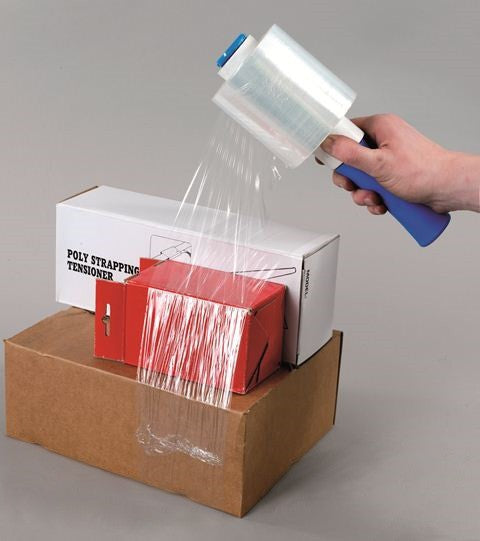
Stretchwrap / Mini Stretch Wrap
-
100x300 - 17mic Mini Pallet Wrap BlackRegular price From £2.24 GBPRegular priceUnit price per
-
100x150 - VP6 Mini Pallet Wrap - RedRegular price £0.00 GBPRegular priceUnit price per
-
100x150 - 25mic Mini Pallet Wrap - BlackRegular price From £1.57 GBPRegular priceUnit price per
-
100x300 - 17mic Mini Pallet WrapRegular price From £2.74 GBPRegular priceUnit price per
-
100x150 - 15mic Mini Pallet WrapRegular price From £1.64 GBPRegular priceUnit price per


Ideal for securing small boxes or bundling awkward items. Can be applied in confined spaces and leaves no residue on the product as it only sticks to itself.
- Easy to use
- Economical - Stretches up to 3 times its original length
- Also available in black
Stretchwrap / Mini Stretch Wrap
| Order Code | Description | Width (mm) | Length (mm) | Grade | Core | Pack Quantity |
| 16A116 | Megastretch handywrap 110S | 100 | 300 | Standard | Extended | 40 |
Mini Stretch Wrap (Handy Wrap) for Small Bundles & Confined-Space Wrapping
Mini stretch wrap (often called handy wrap) is a narrow-width stretch film designed for fast, controlled bundling and stabilising of smaller items. Because the film clings to itself rather than to the product surface, it is commonly used where you want secure containment without adhesive residue. Mini rolls are especially useful at packing benches, in vehicles, and in tight areas where full-size hand stretch film is awkward.
Within this collection you’ll find compact rolls suited to securing small cartons, grouping multiple items into one manageable unit, and protecting products from scuffs, dust, and light moisture during handling. Options include different widths and colours, plus extended-core styles that act as an integrated handle for quick application.
Stretchwrap / Mini Stretch Wrap — Helpful Guide
Mini stretch wrap is essentially the same concept as pallet stretch film, but scaled down for hand use on smaller loads. The key variables are width (how much coverage you get per pass), film thickness (durability and puncture resistance), roll length (how long the roll lasts), and core style (how it feels in the hand and whether you need a dispenser).
Types of mini stretch wrap in this category
-
Extended-core mini stretch wrap (built-in handle)
The cardboard core extends beyond the film edges, creating a comfortable grip. This is ideal for quick, occasional wrapping where you want to pick up a roll and start bundling immediately—no separate handle required.Related product on this page: Megastretch handywrap 110S (100 mm x 300 m, extended core). A compact, easy-to-control roll for securing small boxes and bundling awkward shapes.
-
Coloured mini stretch wrap (identification & concealment)
Coloured film helps with quick visual identification (e.g., sorting by destination, batch, or priority) and can reduce product visibility during transit. Darker colours can also help conceal contents while still providing stretch-film containment.Related products on this page: 100x300 - 17mic Mini Pallet Wrap Black and 100x150 - VP6 Mini Pallet Wrap - Red.
-
General-purpose mini pallet wrap (everyday bundling)
A versatile option for day-to-day packing tasks such as grouping items, stabilising small cartons, and keeping components together through picking, packing, and dispatch.Related product on this page: 100x150 - 25mic Mini Pallet Wrap (a heavier-duty mini wrap option for more demanding bundles).
Where Mini Stretch Wrap Works Best
- Bundling long or awkward items: pipes, profiles, rods, trim, and grouped cartons where tape would be slow or leave marks.
- Unitising multiple items: keeping sets together (e.g., parts kits) so nothing separates during handling.
- Stabilising small cartons: adding containment around a box to reduce flap lift or shifting contents (especially useful for irregular shapes).
- Protection during handling: reducing scuffs and light surface contamination; useful as a quick outer wrap for items moving between work areas.
- Confined-space wrapping: vehicles, narrow aisles, or tight packing stations where full-width film is cumbersome.
Case Study: Reducing Picking Errors and Transit Damage on Small Orders
A warehouse shipping many small, mixed-item orders often faces two recurring issues: (1) items from the same order separating during picking and staging, and (2) small cartons opening or deforming when handled repeatedly. By switching from tape-only bundling to mini stretch wrap for order consolidation, pickers can quickly unitise items into a single, stable bundle without adhesive contact on product surfaces.
In practice, teams typically wrap just enough to create containment and friction between items, then add a shipping label to the outer carton or to a label pouch. Coloured mini wrap can also be used as a simple visual cue—helping staff identify priority orders or route groups at a glance. The result is fewer loose items at dispatch and less rework caused by split orders.
How to Choose the Correct Mini Stretch Wrap
Choosing the right mini stretch wrap is mainly about matching the film to the weight, shape, and handling conditions of your bundle. Use the guide below to narrow down the best option.
1) Choose the width (coverage vs control)
- 100 mm width: Maximum control for small bundles, narrow items, and tight wrapping patterns. Great for securing corners, handles, and small cartons without excessive overlap.
- 150 mm width: A balanced option for general bundling—faster coverage than 100 mm while still easy to handle.
- 300 mm length rolls: Longer rolls reduce changeovers and are convenient for frequent use at packing benches.
If you’re wrapping items with lots of protrusions or sharp corners, narrower film can help you “work around” the shape with less risk of snagging.
2) Choose the thickness (durability and puncture resistance)
- 17 micron: Suitable for light-to-medium duty bundling where edges are smooth and the bundle won’t be dragged across rough surfaces. Often chosen for speed and economy on standard tasks.
- 25 micron: Better for heavier bundles, sharper edges, or situations where the wrap may be bumped, rubbed, or handled multiple times. The extra thickness generally improves puncture resistance and holding force.
As a rule of thumb: if you frequently see tears during application or the wrap “necks down” too much under tension, moving up in thickness can improve performance.
3) Choose the core style (comfort and consistency)
- Extended core: Built-in handle feel; quick to deploy; ideal for occasional wrapping or mobile use.
- Standard core (with dispenser): Best when you want consistent tension and reduced hand fatigue over repeated cycles. A handle can also help keep the film edges aligned for neater wraps.
4) Choose the colour (visibility and privacy)
- Black: Helps conceal contents and can reduce visual clutter on mixed pallets or in staging areas.
- Red (and other colours): Useful for identification—such as separating routes, marking urgent orders, or distinguishing product groups.
Best-Practice Application Tips (Cleaner Wraps, Less Waste)
- Start with an anchor: Wrap 2–3 turns around the bundle to create a secure base before applying tension.
- Use controlled tension: Stretch film works best when slightly stretched; too much tension can cause tearing or distortion of light cartons.
- Overlap consistently: Aim for steady overlap (often around half the film width) to build strength without excessive layers.
- Reinforce edges and corners: Add extra passes where abrasion is likely—corners, handles, and protrusions.
- Finish with a press-down: Because the film clings to itself, pressing the tail firmly onto the wrapped layers helps prevent lift.
Common Mistakes to Avoid
- Wrapping dusty or wet surfaces: While the film clings to itself, contamination can reduce friction between layers and make the wrap easier to unwind.
- Using light film on sharp edges: If your products have corners, staples, or rough surfaces, consider a thicker option to reduce punctures.
- Over-wrapping: Too many layers can waste film and make bundles hard to open. Use only what’s needed for containment.
- Ignoring ergonomics: For high-volume use, a handle/dispenser and a consistent wrapping method can reduce fatigue and improve wrap quality.
Storage, Handling, and Disposal Notes
- Store clean and dry: Keep rolls away from dust and moisture to maintain consistent cling and unwind.
- Avoid heat and direct sunlight: Excess heat can soften film and affect performance; UV exposure over time can degrade plastics.
- Rotate stock: Use older rolls first to keep performance consistent.
- Recycle where available: Stretch film is commonly collected as soft plastic; follow local recycling guidance for LDPE/LLDPE films.
Mini Stretch Wrap vs Tape vs Strapping (When to Use What)
Mini stretch wrap is often chosen when you need fast bundling without adhesive contact on the product. Tape can be better for sealing cartons, while strapping is typically used for rigid reinforcement of heavy loads. In many packing workflows, mini wrap complements these methods: tape seals the carton, and mini wrap adds containment or groups multiple cartons/items together.
- Choose mini stretch wrap for bundling, unitising, and quick containment.
- Choose tape for carton sealing and tamper-evident closure.
- Choose strapping for heavy, rigid reinforcement or when loads need high compression strength.
Questions & Answers
Does mini stretch wrap leave residue on products?
Mini stretch wrap typically clings to itself rather than using adhesive, so it generally does not leave sticky residue on the product surface. Residue issues are more commonly associated with tapes. For best results, wrap onto clean, dry layers so the film bonds to itself.
How do I choose between 17 micron and 25 micron mini wrap?
Use 17 micron for light-to-medium bundles with smooth edges and minimal abrasion during handling. Choose 25 micron when bundles are heavier, have sharper corners, or will be moved multiple times. Thicker film usually improves puncture resistance and holding strength.
What is an extended core, and when is it useful?
An extended core is a cardboard core that protrudes beyond the film edges, creating a built-in handle. It’s useful for quick, occasional wrapping because you can apply the film without a separate dispenser. It can also improve control in tight spaces or mobile packing.
Is coloured mini stretch wrap only for appearance?
Coloured mini wrap is often used for practical reasons such as identifying routes, batches, or priority orders at a glance. Dark colours can also reduce visibility of contents. The core function remains containment and bundling; colour mainly supports organisation and handling workflows.
How many layers of mini stretch wrap should I apply?
Apply enough layers to prevent shifting and to keep the tail secured—often a few anchoring turns plus consistent overlap around the bundle. Over-wrapping wastes film and can make bundles difficult to open. If tearing occurs, reduce tension or consider a thicker film.