
Strapping / Buckles & Seals / Metal Seals
-
12x30mm - Semi Open Serrated Metal SealsRegular price From £55.83 GBPRegular priceUnit price per
-
25mm x 57mm - Heavy Duty Lapover Metal SealsRegular price From £70.11 GBPRegular priceUnit price per
-
25mm x 57mm - Lapover Metal SealsRegular price From £88.29 GBPRegular priceUnit price per
-
12x25mm - Semi Open Metal SealsRegular price From £34.88 GBPRegular priceUnit price per
-
19mm x 25mm - Heavy Duty Lapover Metal SealsRegular price From £33.42 GBPRegular priceUnit price per
-
19mm x 25mm - Lapover Metal SealsRegular price From £33.42 GBPRegular priceUnit price per
-
19mm - Snap-On Metal SealsRegular price From £26.52 GBPRegular priceUnit price per
-
16x25mm Semi Open Serrated Metal SealsRegular price From £17.10 GBPRegular priceUnit price per
-
16mm x 25mm - Heavy Duty Lapover Metal SealsRegular price From £33.42 GBPRegular priceUnit price per
-
16mm x 25mm - Lapover Metal SealsRegular price From £33.42 GBPRegular priceUnit price per
-
16x25mm - Heavy Duty Semi-Open Metal SealsRegular price From £12.29 GBPRegular priceUnit price per
-
16mm - Snap-On Metal SealsRegular price From £201.90 GBPRegular priceUnit price per
-
13mm x 25mm - Heavy Duty Lapover Metal SealsRegular price From £28.84 GBPRegular priceUnit price per
-
13mm x 25mm - Lapover Metal SealsRegular price From £27.55 GBPRegular priceUnit price per
-
13mm - Snap-On Metal SealsRegular price From £24.02 GBPRegular priceUnit price per


For use with hand strapping, applied with a tensioner and sealer on:
- Polypropylene
- Polyester
- Steel strapping
Strapping / Buckles & Seals / Metal Seals
Serrated


| Order Code | Description | Pack Quantity |
| 17C30 | PP and PET strapping seal serrated 12 x 25mm | 1000 |
| 17C16S | PP and PET strapping seal serrated 16 x 25mm | 1000 |

Semi-open heavy duty
| Order Code | Description | Pack Quantity |
| 17C16H | PP strapping seal heavy | |
| duty semi-open 16 x 32mm | 2000 |

Semi-open
| Order Code | Description | Pack Quantity |
| 17C25 | PP strapping seal standard | |
| semi-open 12 x 25mm | 2000 |

Snap on
| Order Code | Description | Pack Quantity |
| 17C13 | Snap-on seal 13mm x 25mm | 1000 |
| 17C16 | Snap-on seal 16mm x 25mm | 1000 |
| 17C19 | Snap-on seal 19mm x 25mm | 1000 |
 Standard lapover
| Order Code | Description | Pack Quantity |
| 17C13L | Standard lapover seal | |
| 13mm x 25mm | 1000 | |
| 17C16L | Standard lapover seal | |
| 16mm x 25mm | 1000 | |
| 17C19L | Standard lapover seal | |
| 19mm x 25mm | 1000 | |
| 17C25L | Standard lapover seal | |
| 25mm x 25mm | 1000 |

Heavy duty lapover
| Order Code | Description | Pack Quantity | |||||||||||||||
| 17C13LH | Heavy duty lapover seal | ||||||||||||||||
| 13mm x 45mm | 1000 | ||||||||||||||||
| 17C16LH | Heavy duty lapover seal | 16mm x 45mm | 1000 | 17C19LH | Heavy duty lapover seal | 19mm x 45mm | 1000 | 17C25LH | Heavy duty lapover seal | 25mm x 45mm | 100 |
Metal Strapping Seals for Hand Strapping
Metal seals are the small but critical components that lock strapping in place after tension is applied. In hand-strapping applications, a seal is positioned over overlapped strap ends, the strap is tensioned, and then a compatible sealer crimps the seal to create a mechanical joint. This collection focuses on metal seals used with hand tools on polypropylene (PP), polyester (PET), and (in some applications) steel strapping, where consistent joint formation and correct sizing are essential for load stability during handling, storage, and transport.
On this page you’ll find serrated seals and heavy-duty semi-open seals designed to be crimped with a sealer. Selecting the correct seal depends on strap material, strap width, strap thickness, and the type of sealer being used.
Strapping / Buckles & Seals / Metal Seals — Helpful Guide
This guide explains the main metal seal styles in this category, what they’re used for, and how to match them to your strapping and tools. A simple rule of thumb is that the seal width should match the strap width (for example, a 12 mm seal is intended for 12 mm strapping). Seal length (such as 25 mm) relates to the seal’s contact area and crimp pattern.
1) Serrated metal seals (for PP & PET strapping)
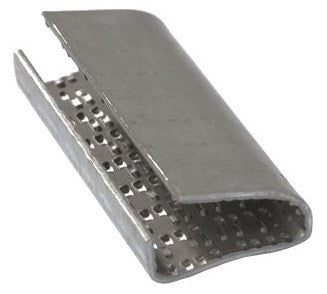
Serrated seals have internal teeth that bite into the strapping when crimped. They are commonly used with PP and PET strapping in hand-tool applications because the serrations help resist strap slip after tensioning. These seals are typically used with a tensioner and a matching sealer that forms the correct crimp profile.
-
PP and PET strapping seal serrated 12 x 25mm (Order Code: 17C30)
Designed for 12 mm PP/PET strapping. The 25 mm length provides crimp area for a secure mechanical joint when used with a compatible sealer. -
PP and PET strapping seal serrated 16 x 25mm (Order Code: 17C16S)
Designed for 16 mm PP/PET strapping. Use with a sealer sized for 16 mm serrated seals to achieve consistent tooth engagement and crimp formation.
2) Semi-open heavy-duty metal seals (for higher-tension hand strapping)
Semi-open seals are shaped to make positioning easier during application, especially when working quickly or when access around the load is limited. “Heavy-duty” versions are typically used where higher tension is applied or where additional joint robustness is required. As with all seals, tool compatibility is critical: the sealer must match the seal type and strap width to form the intended crimp.
-
PP strapping seal heavy duty semi-open (Order Code: 17C16H)
A heavy-duty semi-open seal intended for PP strapping applications where a stronger crimped joint is required. Match to the correct strap width and sealer.
Case Study: Stabilising a Mixed Carton Pallet for Warehouse Transfer
A warehouse team needed to stabilise a pallet of mixed cartons for internal transfer between buildings. Stretch wrap alone reduced shifting, but the pallet still experienced corner compression and minor carton movement when handled by forklift. The team added two horizontal straps around the pallet and used metal seals with a hand tensioner and sealer.
Key outcomes came from process control rather than higher tension: the operator ensured consistent strap alignment, used seals sized to the strap width, and applied the same crimp sequence each time. The result was a repeatable joint and improved load integrity during handling. This type of scenario highlights why seal selection and tool matching matter—an incorrect seal width or incompatible sealer can lead to uneven crimps and strap slip, even when the strap itself is suitable.
How to Choose the Correct Metal Seal
Step 1: Match seal width to strap width
Seal width should match the strapping width. For example, a 12 x 25 mm seal is typically intended for 12 mm strapping, and a 16 x 25 mm seal for 16 mm strapping. Using a wider seal on a narrower strap can reduce tooth engagement and crimp consistency; using a narrower seal on a wider strap can prevent proper insertion and crimp formation.
Step 2: Confirm strap material and surface behaviour
PP and PET behave differently under tension and over time. PET generally holds tension better than PP, while PP can be more prone to relaxation depending on load and environment. Serrated seals are commonly used with both PP and PET because the teeth help resist slip. For steel strapping, seal and tool requirements can differ significantly; always confirm that the seal style and sealer are intended for steel strapping if that is your application.
Step 3: Check strap thickness (gauge) and duty level
Even at the same width, strapping thickness affects how the seal crimps and how much material the teeth can bite into. If the strap is unusually thick or thin for the tool and seal combination, the crimp may be under-formed or over-formed. Heavy-duty seals are often chosen when higher tension is applied or when the joint needs additional robustness, but they still must be compatible with the strap gauge and sealer.
Step 4: Match the seal to the sealer (tool compatibility)
Hand strapping systems rely on a matched set: strap, tensioner, seal, and sealer. A sealer designed for serrated seals may not form the correct crimp on a semi-open seal, and vice versa. Also ensure the sealer is sized for the strap width (e.g., 12 mm or 16 mm). Correct tool matching helps produce consistent crimps, reduces rework, and improves joint reliability.
Step 5: Consider the load and handling conditions
Seal choice is influenced by how the load will be handled: forklift impacts, vibration in transit, temperature changes, and long storage periods can all affect strap tension and joint performance. For loads that may settle or compress, maintaining a stable joint becomes more important. In these cases, ensure the seal type and crimp profile are appropriate for the strap material and expected tension retention.
Common Application Tips (Hand Strapping)
- Keep strap overlap consistent: Ensure the strap ends overlap enough to fully seat inside the seal before crimping.
- Square the seal to the strap: Misalignment can cause uneven crimping and reduce holding strength.
- Use the correct crimp sequence: Many sealers require multiple crimps along the seal length; follow the tool’s intended pattern for repeatability.
- Inspect the crimp: A good crimp is uniform, with clear deformation of the seal into the strap. If the seal is barely formed or excessively crushed, re-check tool compatibility and strap gauge.
- Don’t over-tension: Excessive tension can damage cartons, deform edges, or create a joint that fails under shock. Aim for sufficient tension to stabilise the load without crushing it.
Troubleshooting: When a Strapping Joint Slips or Fails
Seal slips on the strap
- Seal width does not match strap width.
- Incorrect seal type for the sealer (crimp profile mismatch).
- Insufficient crimping force or incomplete crimp sequence.
- Strap surface contamination (dust, oil, moisture) reducing friction and tooth bite.
Seal cracks or deforms excessively
- Over-crimping or using a sealer not intended for that seal style.
- Seal duty level not appropriate for applied tension.
- Strap gauge outside the intended range for the seal/tool combination.
Strap breaks near the seal
- Over-tensioning or sharp edges on the load creating stress concentration.
- Misaligned seal causing uneven load distribution.
- Strap damaged during handling or by tool wear.
Safety and Handling Notes
Strapping under tension stores energy. Always wear appropriate eye and hand protection, keep bystanders clear during tensioning and cutting, and use cutters designed for the strap type. Ensure tools are maintained so that tensioning and crimping actions are smooth and controlled.
Questions & Answers
What is the difference between serrated seals and semi-open seals?
Serrated seals have internal teeth that bite into PP or PET strapping when crimped, helping resist slip. Semi-open seals are shaped for easier positioning during application and are often used in heavier-duty hand-strapping setups where consistent placement and robust crimping are needed.
How do I choose the correct seal size (for example 12 x 25 mm vs 16 x 25 mm)?
Match the seal width to the strap width: 12 x 25 mm seals are typically for 12 mm strapping, and 16 x 25 mm seals for 16 mm strapping. The 25 mm length relates to crimp area. Also confirm strap thickness and tool compatibility.
Do I need a specific sealer for each type of metal seal?
Yes. Sealers are designed to form a particular crimp profile for a given seal style and strap width. Using the wrong sealer can produce an incomplete or uneven crimp, which may lead to strap slip or joint failure even if the seal size seems correct.
Can the same metal seals be used on polypropylene and polyester strapping?
Many serrated seals are intended for both PP and PET strapping, but you should still confirm the seal specification and ensure the sealer is appropriate. PP and PET differ in stiffness and tension retention, so correct crimp formation and sizing are important for both materials.
What are common signs that a crimped seal joint is not formed correctly?
Warning signs include visible strap movement inside the seal, uneven or partial crimp marks, a seal that looks barely deformed, or a seal crushed excessively. These issues often indicate mismatched seal width, incorrect sealer type, incomplete crimping, or strap thickness outside the intended range.