
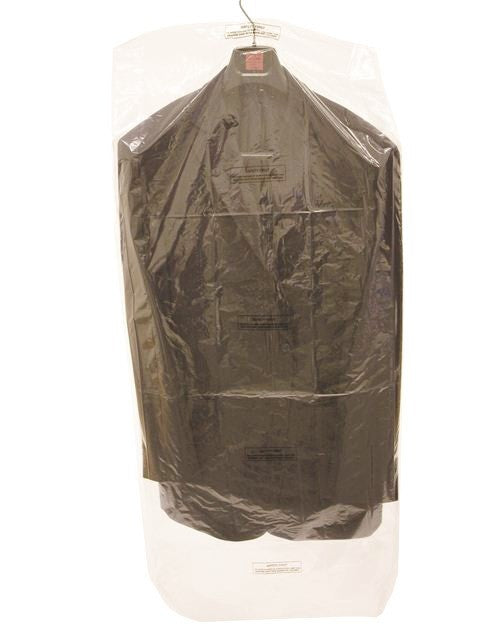
Bags / Garment Bags & Covers / Garment Covers - Shaped
-
20”x30”x78” - 100g Shaped Garment CoversRegular price From £80.17 GBPRegular priceUnit price per
-
24x32x54" - 80g Clear Poly CoversRegular price From £37.59 GBPRegular priceUnit price per
-
54”x23” - 50g Shaped Garment CoversRegular price From £33.13 GBPRegular priceUnit price per
-
19x23x36” - 90g Garment Covers on a Roll - 10kgRegular price From £64.96 GBPRegular priceUnit price per
-
30”x23” - 50g Shaped Garment CoversRegular price From £37.95 GBPRegular priceUnit price per


Shaped garment covers are specifically designed to protect delicate and structured garments like suits, dresses, and coats.
See also: Garment Cover-On-Roll
Bags / Garment Bags & Covers / Garment Covers - Shaped
Shaped Garment Covers
| Order Code | Description | Size (Inches) | Size (mm) | Thickness (Gauge) | Pack Quantity |
| 09G30 | Garment covers | 23 x 30 | 585 x 760 | 50 | 1000 |
| 09G36 | Garment covers | 23 x 36 | 585 x 915 | 50 | 1000 |
| 09G54 | Garment covers | 23 x 54 | 585 x 1370 | 50 | 1000 |
| 09G78 | Garment covers | 20 x 30 x 78 | 510 x 585 x 1980 | 50 | 100 |
Shaped garment covers are a practical way to protect structured apparel during storage, transport, and order handoff. Unlike flat garment bags, a shaped cover follows the shoulder line of the hanger, helping the film drape smoothly over jackets, coats, uniforms, gowns, and other items that benefit from a contoured top. This reduces bunching at the neckline and helps keep lapels, shoulder pads, pleats, and embellishments from rubbing against adjacent garments.
Shaped Garment Covers — Helpful Guide
This category focuses on shaped (shoulder-form) garment covers commonly used in garment care, tailoring, costume departments, uniform programs, and retail back-of-house operations. They are typically made from clear polyethylene film and supplied in bulk pack quantities for efficient daily use. The shaped top is designed to sit neatly on a hanger and provide consistent coverage down the length of the garment.
What “shaped” means (and why it matters)
- Contoured shoulder area: The top of the cover is formed to match the hanger’s shoulder line, helping the cover hang straight and reducing stress points around the collar.
- Cleaner presentation: A smoother drape can improve how garments look when staged for pickup, delivery, or rack storage.
- Reduced snag risk: Less excess film at the top can mean fewer folds that catch on zippers, buttons, sequins, or hook-and-loop closures.
- More consistent length coverage: When the cover starts correctly at the shoulder, the bottom length is easier to predict and select.
Types of shaped garment covers in this collection
The products on this page are shaped garment covers offered in multiple lengths. Use the size (inches) to match the garment length you need to protect.
-
09G30 Garment covers (23 x 30)
Short-length shaped cover suited to cropped jackets, children’s formalwear, short uniforms, or folded items on hangers where full-length coverage is not required. -
09G36 Garment covers (23 x 36)
Mid-length shaped cover commonly used for suit jackets, blazers, chef coats, and many uniform garments that extend below the hip but not to full dress length. -
09G54 Garment covers (23 x 54)
Long-length shaped cover intended for longer garments such as coats, gowns, choir robes, and dresses where hem protection and full-length dust shielding are priorities.
If you need a continuous-feed option for high-throughput operations, see the related collection linked above for cover-on-roll formats.
Common use cases
- Dry cleaning and laundry finishing: Protects garments after pressing/finishing from dust, lint, and incidental contact during staging and pickup.
- Tailoring and alterations: Helps keep finished items clean between fittings and during customer handoff.
- Uniform programs: Supports sorting and distribution by keeping garments separated on racks.
- Costume and wardrobe departments: Helps reduce abrasion and keeps garments organized during transport between locations.
- Retail stockrooms: Useful for protecting display-ready apparel and keeping backstock clean.
Case study: reducing re-cleaning and re-pressing from rack contamination
A garment care operation handling mixed orders (suits, dresses, and outerwear) noticed that finished items staged on rolling racks were picking up lint and dust, especially during busy pickup windows. The team standardized on shaped covers by garment length: shorter covers for jackets, mid-length for suits, and long covers for dresses and coats. By matching cover length to garment type and ensuring the cover started at the shoulder line, they reduced film bunching at the collar and improved rack organization. Over time, fewer items required touch-up pressing due to surface contamination, and staff spent less time re-bagging garments that slipped out of flat-top covers.
How to choose the correct shaped garment cover
1) Choose the right length
Length is the most important selection factor. A cover that is too short leaves hems exposed; too long can drag or bunch at the bottom, increasing the chance of tearing or catching on rack hardware.
- 23 x 30: Best for short garments and compact coverage.
- 23 x 36: A versatile mid-length option for many jackets and uniforms.
- 23 x 54: Best for long garments where full-length protection matters.
2) Consider width and hanger fit
The 23-inch width is designed to accommodate many common hanger widths while still draping neatly. If garments are bulky (heavy coats, layered costumes, or padded shoulders), ensure the cover can slide over the garment without excessive stretching at seams or corners.
3) Understand thickness (gauge) in practical terms
Film thickness is often listed in gauge. In day-to-day use, thicker film generally offers better puncture resistance and durability during handling, while thinner film can be easier to dispense and may be sufficient for short-term dust protection. If garments frequently snag (sequins, pins, sharp hanger edges), selecting a more durable thickness can help reduce tearing and re-bagging.
4) Match the cover to the workflow
- High-volume finishing lines: Prioritize consistent sizing and easy application to reduce handling time.
- Delivery routes: Consider longer coverage for garments that may brush against other items in transit.
- Longer storage: Choose a length that fully covers the garment and minimizes open exposure at the bottom.
5) Storage and dispensing tips
- Store covers in a clean, dry area away from heat sources to prevent film distortion.
- Keep cartons closed when not in use to reduce dust accumulation inside the box.
- Train staff to start the cover at the hanger top and pull straight down to avoid twisting and uneven drape.
Handling, safety, and garment-care considerations
- Ventilation and moisture: If garments are still warm or slightly damp after processing, allow adequate cooling/drying time before covering to reduce trapped moisture.
- Avoid sharp edges: Inspect hangers and rack hardware for burrs that can puncture film.
- Keep closures and accessories in mind: Decorative pins, metal buckles, and exposed zippers can snag film; apply covers carefully over these areas.
- Storage duration: For extended storage, periodically check garments for moisture, odor, or compression marks and adjust storage practices as needed.
Frequently asked questions
What is the difference between a shaped garment cover and a flat garment bag?
A shaped garment cover has a contoured shoulder area that follows the hanger line, helping the film drape smoothly over structured garments. Flat bags can bunch at the neckline, which may cause slipping or uneven coverage. Shaped covers are often preferred for jackets, coats, and dresses.
How do I choose the right length for a garment cover?
Measure from the top of the hanger to the garment hem and select a cover length that reaches close to the bottom without dragging. Short lengths suit jackets and compact items, mid lengths fit many uniforms and suits, and long lengths are better for coats and gowns.
What does “gauge” mean for plastic garment covers?
Gauge is a common way to describe plastic film thickness. In general, thicker film is more resistant to punctures and tearing during handling, while thinner film may be adequate for short-term dust protection. Choose thickness based on snag risk, handling frequency, and storage time.
Are shaped garment covers suitable for long-term storage?
They can be used for longer storage when garments are clean and fully dry before covering. For extended periods, avoid compressing garments tightly on racks and periodically check for trapped moisture or odor. Selecting a cover length that fully shields the garment helps reduce dust exposure.
Why do garment covers sometimes tear during application, and how can I reduce it?
Tearing often happens when film catches on sharp hanger edges, zippers, pins, or rack hardware, or when the cover is pulled at an angle. Use smooth hangers, remove or shield sharp accessories when possible, and pull the cover straight down from the shoulder area for even tension.