
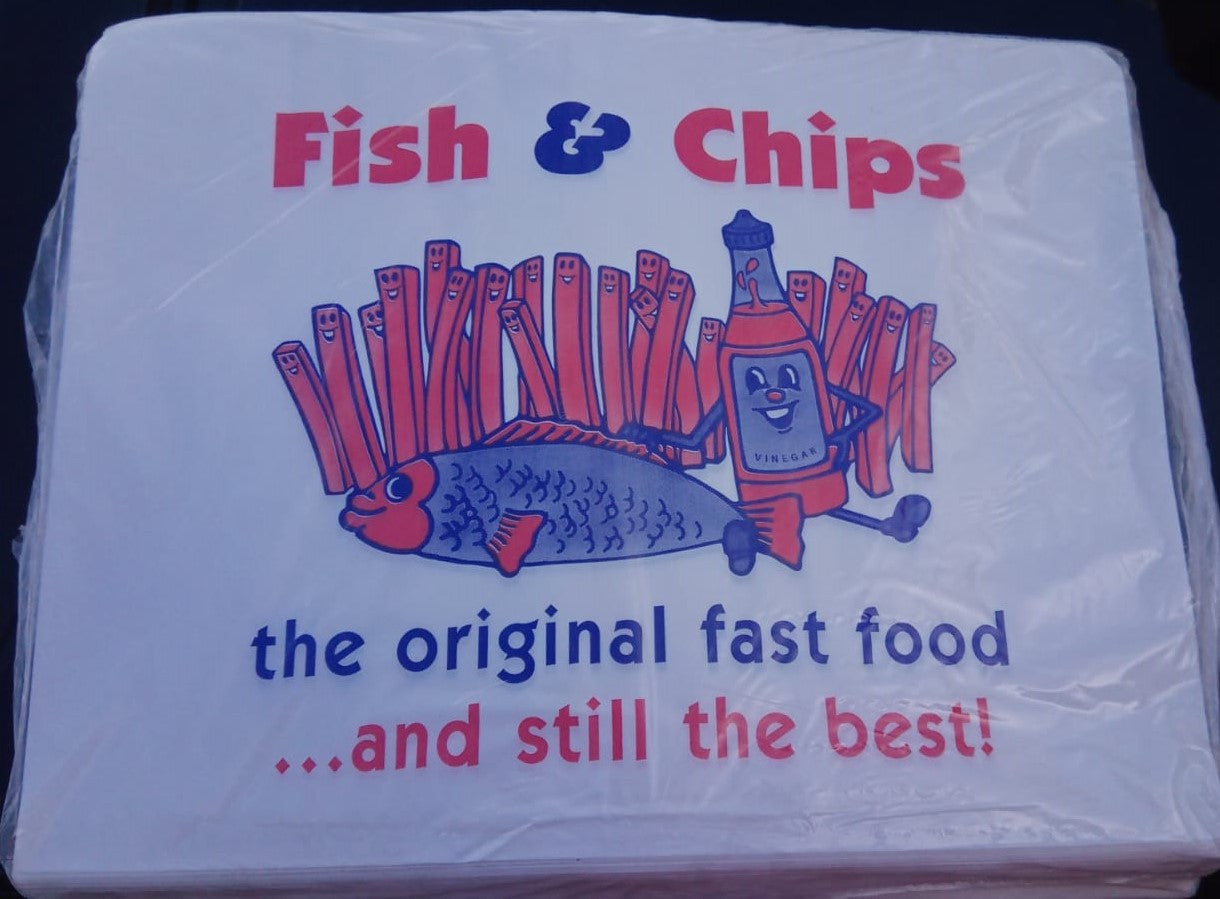
Bags / Paper Bags / Fish & Chip Design
-
13x7x17 SOS - Fish & Chip Design Paper BagsRegular price From £1.99 GBPRegular priceUnit price per
-
14x11 - Fish & Chip Design Paper BagsRegular price From £29.12 GBPRegular priceUnit price per


Bags / Paper Bags / Fish & Chip Design
| Product Code | Description |
| 01C07 | 14x11 - Fish & Chip Design Paper Bags |
Fish & Chip Design Paper Bags: Practical Guide for Takeaway Service
Fish and chip paper bags are a classic takeaway format designed to carry hot, freshly cooked food from counter to customer with minimal fuss. In this collection you’ll find paper bags printed with a fish & chip themed design, suited to quick-service food operations where speed, consistency, and presentation matter. The products in this category focus on two common bag formats/sizes used for takeaway portions and bundled orders.
These bags are typically used for:
- Single portions of fish & chips (wrapped or boxed) placed into a carry bag
- Multiple items combined into one order (chips, fish, sides, sauces)
- Takeaway service where customers need a stable bag that’s easy to hold and transport
- Counter service where fast packing and reliable opening are important
Because hot food can release steam and oils, choosing the right bag size and construction helps reduce leaks, improves handling, and supports a better customer experience.
Fish & Chip Design Paper Bags — Helpful Guide
This guide explains the bag types available in this category and how to match them to typical fish & chip service styles. It also links directly to the products listed on this page so you can compare formats quickly.
1) SOS (Self-Opening Sack) paper bags
SOS bags are flat-bottom paper bags that “pop” open quickly and stand upright on a counter. This makes them a common choice for busy takeaway operations because they are easy to fill, stable during packing, and convenient for customers to carry.
-
13x7x17 SOS - Fish & Chip Design Paper Bags
A self-opening sack style bag with a flat base for stability. The 13x7x17 size is commonly used when you need extra height and a gusset to accommodate bulkier orders, multiple wrapped items, or boxed portions.
2) Flat paper bags (non-SOS format)
Some paper bags are specified by two dimensions (for example width and height) and may be used for lighter loads or where a simpler bag profile is preferred. These can work well for smaller orders, wrapped items, or when the contents are relatively flat.
-
14x11 - Fish & Chip Design Paper Bags
A fish & chip design paper bag in a 14x11 size. This format can suit flatter packs or smaller takeaway combinations where a compact bag is preferred.
Understanding Bag Sizes (and Why They Matter)
Paper bag sizing is often listed as either:
- Width x Gusset x Height (common for SOS bags), or
- Width x Height (common for flatter bag formats)
The gusset is the side fold that expands to create depth. More gusset generally means more capacity and better ability to hold bulky items. Height affects how easily you can fit taller packs and how much room you have to fold the top down for a neater close.
For fish & chips, capacity isn’t the only consideration. The bag also needs to handle:
- Heat from freshly cooked food
- Steam that can soften paper over time
- Oil/grease that can migrate from food packaging to the bag
- Movement during transport (swinging, tilting, stacking in a car seat)
Choosing a bag that’s too small can lead to crushed packaging, poor closure, and higher risk of tearing. Choosing a bag that’s too large can allow items to slide around, increasing the chance of spills and making the order feel less secure.
Case Study: Speeding Up a Busy Friday Service
A takeaway shop experiences a rush period where orders stack up quickly. Staff need a bag that opens fast, stands up on the bench, and can be filled with minimal handling. Switching to a flat-bottom SOS style for larger orders reduces packing time because the bag stays open while items are placed inside. For smaller, flatter orders, a compact bag format can reduce wasted space and keep the order snug.
Operational improvements typically come from:
- Using a stable, self-opening bag for multi-item orders
- Standardising which bag size is used for each menu bundle
- Keeping bags accessible and pre-separated to reduce handling time
- Training staff to place heavier items at the base and lighter items on top
How to Choose the Correct Fish & Chip Paper Bag
Step 1: Identify what goes inside the bag
Start by listing the typical packaging you place inside a carry bag: wrapped fish, chip portions, boxes, trays, sauce pots, napkins, and cutlery. The outer bag must accommodate the largest common combination without forcing items in.
Step 2: Decide whether you need a gusseted, flat-bottom bag
If you regularly pack multiple items or use boxed/trayed portions, a gusseted SOS bag is often easier to fill and more stable on the counter. If your orders are usually flatter and lighter, a simpler bag format may be sufficient.
Step 3: Consider handling and transport
Think about how customers carry the order and how far it travels. A bag that’s too tight can tear at stress points; a bag that’s too loose can let items shift. Aim for a fit that allows items to sit flat with minimal movement.
Step 4: Plan for heat, steam, and grease
Hot food releases steam, and steam can soften paper. If you place very hot items into a bag immediately, allow a brief moment for excess steam to vent, or ensure inner packaging is suitable for hot, oily foods. Keeping sauces sealed and separating them from hot items can also reduce mess.
Step 5: Build a simple bagging standard
Consistency reduces errors. Many shops benefit from a simple rule set such as “small orders use the compact bag; multi-item or boxed orders use the SOS bag.” This helps new staff pack correctly and speeds up service.
Packing Tips for Better Performance
- Balance the load: place heavier items at the bottom and centre to reduce tipping.
- Keep sauces upright: use sealed containers and position them away from hot items where possible.
- Reduce condensation: avoid sealing extremely hot items airtight before bagging; allow steam to escape appropriately.
- Prevent sharp edges: if inner boxes have corners, ensure they sit flat and aren’t forcing against the bag wall.
- Fold the top neatly: a simple fold can improve carry comfort and reduce the chance of items bouncing out.
Common Use Scenarios
Single portion takeaway
For a single wrapped portion or a smaller combination, a compact bag can keep the order snug and easy to carry. The goal is to avoid excess empty space so the contents don’t slide.
Family or multi-item orders
For larger orders with multiple wrapped items, sides, and extras, a gusseted SOS bag provides more capacity and stability. It also makes packing faster because the bag stands open while items are loaded.
Click-and-collect peak times
When orders are staged for pickup, bags may sit for several minutes. Choosing a bag that holds its shape and supports the inner packaging helps maintain presentation and reduces the chance of tearing when the customer lifts the order.
Q&A
What does “SOS” mean on a paper bag?
SOS stands for Self-Opening Sack. It describes a flat-bottom paper bag designed to open quickly and stand upright. This makes it easier to fill during busy service and helps keep takeaway items stable while packing and carrying.
How do I choose the right bag size for fish and chips?
Match the bag to your most common order combinations. Consider the inner packaging (wraps, boxes, trays, sauce pots) and choose a size that fits without forcing items in. A snug fit reduces movement; extra gusset adds capacity for bulkier orders.
Why do hot takeaway orders sometimes soften or weaken paper bags?
Heat and steam from freshly cooked food can add moisture to paper fibres, reducing stiffness over time. Condensation is more likely when very hot items are bagged immediately. Allowing brief venting and using suitable inner packaging can help reduce moisture transfer.
Are gusseted bags better for multi-item orders?
Often, yes. Gussets add depth and allow the bag to expand, which helps accommodate multiple items and boxed portions. A flat-bottom gusseted bag also tends to stand more securely on the counter, making packing faster and reducing the chance of tipping.
What’s the best way to pack sauces and sides in a takeaway bag?
Use sealed containers, keep them upright, and position them away from the hottest items to reduce leakage risk. Place heavier items at the bottom and lighter items on top. Minimising empty space helps prevent shifting during transport and improves overall stability.