
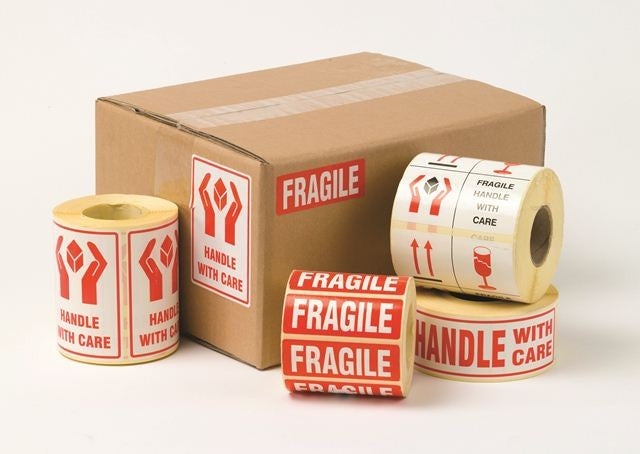
Branding / Labels / Printed Parcel Labels
-
 Sold out"SOLD" - Write On LabelsRegular price From £0.01 GBPRegular priceUnit price per
 -
 Sold out6"x4" - "This Way Up" LabelsRegular price From £14.70 GBPRegular priceUnit price per
 -
148x50mm - VL148 "Handle With Care" LabelsRegular price From £16.12 GBPRegular priceUnit price per
-
148x50mm - VL148 "Glass With Care " LabelsRegular price From £15.69 GBPRegular priceUnit price per
-
 Sold out148x50mm - VL148 "Fragile" LabelsRegular price From £18.74 GBPRegular priceUnit price per
 -
148x50mm - VL148 "Caution! Heavy Package" LabelsRegular price From £14.70 GBPRegular priceUnit price per
-
108x79mm - VL108 "This Way Up" LabelsRegular price From £23.06 GBPRegular priceUnit price per
-
108x79mm - VL108 "Handle With Care" LabelsRegular price From £8.87 GBPRegular priceUnit price per
-
108x79mm - VL108 "Fragile Handle With Care" LabelsRegular price From £14.70 GBPRegular priceUnit price per
-
 Sold out108x79mm - VL108 "Fragile" LabelsRegular price From £21.24 GBPRegular priceUnit price per
 -
108x79mm - VL108 "Do Not Stack" LabelsRegular price From £14.70 GBPRegular priceUnit price per
-
108x79mm - VL108 "Do Not Stack" LabelsRegular price From £14.70 GBPRegular priceUnit price per
-
 Sold out89x32mm - VL89 "Urgent" LabelsRegular price From £14.70 GBPRegular priceUnit price per
 -
 Sold out89x32mm - VL89 "Sold" LabelsRegular price From £14.70 GBPRegular priceUnit price per
 -
89x32mm - VL89 "Handle with Care - Liquid" LabelsRegular price From £14.70 GBPRegular priceUnit price per
-
89x32mm - VL89 "Handle With Care" LabelsRegular price From £14.70 GBPRegular priceUnit price per
-
 Sold out89x32mm - VL89 "Glass" LabelsRegular price From £14.70 GBPRegular priceUnit price per
 -
 Sold out89x32mm - VL89 "Fragile" LabelsRegular price From £16.79 GBPRegular priceUnit price per
 -
89x32mm - VL89 "Document Enclosed" LabelsRegular price From £18.88 GBPRegular priceUnit price per
-
 Sold out89x32mm - VL89 "Do Not Bend" LabelsRegular price From £14.70 GBPRegular priceUnit price per
 -
60 x 75mm - Tip N Tell Parcel Indicator LabelsRegular price From £180.15 GBPRegular priceUnit price per


Branding / Labels / Printed Parcel Labels
Printed Parcel Labels for Clearer Handling, Faster Sorting & Fewer Delivery Issues
Printed parcel labels are a simple, highly visible way to communicate handling instructions and shipment status directly on the outside of a package. When a parcel moves through multiple touchpoints (pick/pack, carrier collection, depot sorting, last-mile delivery, and customer receipt), clear labels help reduce avoidable damage, misrouting, and delays by making key instructions obvious at a glance.
This collection focuses on commonly used handling and status messages such as Fragile, Handle With Care, This Way Up, Do Not Bend, Do Not Stack, Urgent, Document Enclosed, Glass, Handle with Care - Liquid, and Caution! Heavy Package, plus a specialist Tip N Tell parcel indicator label for monitoring orientation during transit. Sizes in this range include compact formats (e.g., 89x32mm), mid-size labels (e.g., 108x79mm), larger labels (e.g., 148x50mm), and a prominent 6"x4" format for high-visibility messaging.
Printed Parcel Labels — Helpful Guide
Below is a practical guide to the label types in this category and when to use them. Product names are linked so you can quickly review the exact label format and size.
1) Orientation & stacking control labels
These labels help keep goods upright and prevent crushing or load damage. They are especially useful for items with internal components, liquids, fragile assemblies, or products packed with void fill that can shift if inverted.
-
6"x4" - "This Way Up" Labels
Large, easy-to-spot orientation labels suited to outer cartons where handlers need immediate direction. -
108x79mm - VL108 "This Way Up" Labels
Mid-size orientation labels that fit well on cartons, mailers, and shrink-wrapped packs. -
108x79mm - VL108 "Do Not Stack" Labels
Helps prevent top-loading that can crush contents or deform packaging during storage and transit. -
108x79mm - VL108 "Do Not Stack" Labels
Alternative listing for the same instruction in the VL108 size; useful when standardising across packing stations.
2) Fragile & careful handling labels
Fragile and care labels set expectations for gentler handling. They work best when paired with appropriate internal protection (e.g., cushioning, corner protection, void fill) and a correctly sized outer carton.
-
148x50mm - VL148 "Fragile" Labels
High-visibility fragile labels for outer cartons and larger packs. -
108x79mm - VL108 "Fragile" Labels
Mid-size fragile labels suitable for a wide range of parcel sizes. -
89x32mm - VL89 "Fragile" Labels
Compact fragile labels for smaller cartons, inner packs, or where label space is limited. -
148x50mm - VL148 "Handle With Care" Labels
Clear handling instruction for general delicate goods and presentation-sensitive items. -
108x79mm - VL108 "Handle With Care" Labels
Mid-size handling labels that balance visibility with efficient label placement. -
89x32mm - VL89 "Handle With Care" Labels
Compact handling labels for smaller parcels or secondary packaging. -
108x79mm - VL108 "Fragile Handle With Care" Labels
Combined message for shipments where both fragility and careful handling must be emphasised.
3) Glass & liquid-specific handling labels
Glass and liquid shipments often need both protective packaging and clear external messaging. Labels help communicate risk to handlers, but they should be used alongside robust internal packing (e.g., dividers, cushioning, absorbent materials where appropriate) and leak-resistant primary containers.
-
148x50mm - VL148 "Glass With Care" Labels
Designed for glass items where breakage risk is high and careful handling is essential. -
89x32mm - VL89 "Glass" Labels
Compact glass identification label for smaller packs or inner cartons. -
89x32mm - VL89 "Handle with Care - Liquid" Labels
Useful for parcels containing liquids where upright handling and gentle movement reduce leak risk.
4) Heavy parcel warning labels
Heavy packages can be a manual handling risk and are more likely to be dropped if not anticipated. A clear warning helps handlers prepare for safe lifting and encourages better placement during stacking and vehicle loading.
-
148x50mm - VL148 "Caution! Heavy Package" Labels
Prominent warning label for heavier cartons and awkward loads.
5) Document & admin labels
These labels help ensure paperwork is noticed and processed correctly. They are commonly used for invoices, packing slips, customs documents, returns paperwork, or installation instructions included with the shipment.
-
89x32mm - VL89 "Document Enclosed" Labels
Highlights that important paperwork is included, reducing the chance it is overlooked on receipt.
6) Flat-pack protection labels
Flat items such as documents, prints, thin boards, and certain retail packs can be damaged by bending. A clear instruction helps reduce creasing and corner damage, especially when parcels are handled in bulk.
-
89x32mm - VL89 "Do Not Bend" Labels
Compact label for mailers and flat cartons where bending is the primary risk.
7) Priority & status labels
Status labels support internal workflows and customer-facing handling. They are often used in warehouses, retail dispatch, and returns processing to quickly identify what should happen next.
-
89x32mm - VL89 "Urgent" Labels
Helps prioritise time-sensitive shipments during picking, packing, and dispatch. -
89x32mm - VL89 "Sold" Labels
Useful for marking allocated stock or completed orders to prevent accidental rework or mis-picks. -
"SOLD" - Write On Labels
Write-on format for flexible status marking (e.g., order number, date, initials, route, or customer reference).
8) Transit monitoring labels (orientation indicator)
Some shipments benefit from a visible indicator that shows whether a parcel has been tipped or handled outside the intended orientation. This can support quality control, claims documentation, and process improvement by identifying where handling issues may occur.
-
60 x 75mm - Tip N Tell Parcel Indicator Labels
Indicator label designed to reveal if a parcel has been tilted beyond an acceptable angle during transit.
Case Study: Reducing Breakage in a Mixed-Item Dispatch Operation
A dispatch team shipping a mix of glass items, boxed products, and flat printed materials noticed a recurring pattern: damage rates were highest on multi-item orders where the outer carton looked similar regardless of contents. Handlers could not easily tell which parcels needed extra care, and flat items were sometimes placed under heavier cartons during staging.
The team introduced a simple labelling standard at pack-out:
- All cartons containing glass received a 148x50mm - VL148 "Glass With Care" Labels label on two adjacent sides.
- Any carton with delicate components received a 148x50mm - VL148 "Handle With Care" Labels label near the main address label.
- Flat mailers and document packs received a 89x32mm - VL89 "Do Not Bend" Labels label placed on the front face.
- Where orientation mattered (liquids or assemblies), cartons received 108x79mm - VL108 "This Way Up" Labels on two sides.
Alongside improved internal packing, the clearer external messaging helped reduce avoidable handling errors during staging and carrier collection. The biggest operational benefit was consistency: packers no longer had to decide label placement each time, and warehouse staff could identify special-handling parcels instantly.
How to Choose the Correct Printed Parcel Label
Step 1: Identify the primary risk
- Breakage risk: choose a Fragile or Glass label (e.g., VL148 "Fragile" or VL148 "Glass With Care").
- Orientation risk: choose a This Way Up label (e.g., 6"x4" This Way Up or VL108 This Way Up).
- Crush risk: choose Do Not Stack (e.g., VL108 Do Not Stack).
- Bend/crease risk: choose Do Not Bend (e.g., VL89 Do Not Bend).
- Manual handling risk: choose a heavy warning (e.g., VL148 Caution! Heavy Package).
Step 2: Match label size to parcel size and viewing distance
- Small parcels / limited space: 89x32mm labels (VL89) are compact and efficient.
- General cartons: 108x79mm (VL108) provides strong visibility without dominating the pack face.
- Larger cartons / high-visibility needs: 148x50mm (VL148) and 6"x4" formats stand out in busy handling environments.
Step 3: Decide placement for maximum effectiveness
- Place handling labels on two adjacent sides so at least one is visible when stacked.
- Keep labels clear of seams, straps, and heavy tape lines to prevent lifting or wrinkling.
- Avoid covering barcodes or carrier labels; leave a clean area for scanning.
- For orientation labels, align arrows with the true upright position and apply consistently.
Step 4: Use labels as part of a complete packaging system
Labels communicate intent, but they cannot compensate for insufficient protection. For best results, combine clear labelling with appropriate cushioning, void fill, edge protection, and a correctly sized outer carton. When shipping liquids or glass, consider secondary containment and internal separation to reduce the impact of leaks or breakage.
Operational Tips for Standardising Label Use
- Create a pack-out checklist: define which label(s) apply to each product group (glass, liquids, flat items, heavy cartons).
- Keep label sizes consistent: standardising on one or two sizes (e.g., VL89 for small packs and VL108/VL148 for cartons) simplifies training.
- Use write-on labels for exceptions: "SOLD" - Write On Labels can support temporary workflow notes without changing printed stock.
- Audit placement: periodically check that labels are applied flat, visible, and not obscured by tape or stretch wrap.
- Document handling incidents: indicator labels such as Tip N Tell Parcel Indicator Labels can help identify recurring orientation issues and improve packing or carrier handover processes.
Do handling labels guarantee a carrier will follow the instruction?
Labels improve visibility of handling requirements, but they cannot guarantee compliance. They work best when combined with protective packaging and consistent placement. Using clear, standard messages (e.g., “Fragile” or “This Way Up”) helps reduce misunderstandings during fast-paced handling.
Where should I place “This Way Up” labels on a carton?
Apply orientation labels on two adjacent sides so at least one remains visible when cartons are stacked or palletised. Align arrows with the true upright position and keep labels away from seams and heavy tape lines to prevent lifting or distortion.
What’s the difference between VL89, VL108, VL148, and 6"x4" label sizes?
These refer to different label dimensions suited to different parcel sizes and visibility needs. VL89 (89x32mm) is compact for small packs, VL108 (108x79mm) is a versatile mid-size, VL148 (148x50mm) offers higher visibility, and 6"x4" is very prominent.
When should I use “Do Not Bend” versus “Fragile” labels?
Use “Do Not Bend” for flat items where creasing is the main risk (documents, prints, thin boards). Use “Fragile” when impact or crushing could break the contents. In some cases, using both is appropriate if the item is both delicate and bend-sensitive.
What are parcel indicator labels used for?
Parcel indicator labels are used to show whether a package has been tipped or handled outside the intended orientation during transit. They can support internal quality checks and help investigate damage patterns by highlighting potential mishandling points in the distribution chain.