
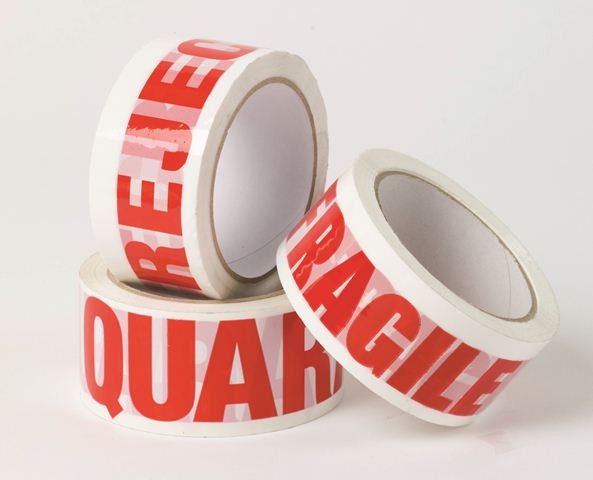
Tapes / Packing Tape (Popular) / Printed
-
50mmx66m - This Way Up LowNoise/LN TapeRegular price £0.00 GBPRegular priceUnit price per
-
50mmx66m - Security LowNoise/LN TapeRegular price £0.00 GBPRegular priceUnit price per
-
50mmx66m - Q.C Rejected Printed TapeRegular price From £1.49 GBPRegular priceUnit price per
-
50mmx66m - Quarantine Printed TapeRegular price £0.00 GBPRegular priceUnit price per
-
50mmx66m - Handle With Care LowNoise/LN TapeRegular price From £1.40 GBPRegular priceUnit price per
-
50mmx66m - Glass Handle With Care LowNoise/LN TapeRegular price From £1.32 GBPRegular priceUnit price per
-
50mmx66m - Fragile LowNoise/LN DENVA Tape 45micRegular price From £0.88 GBPRegular priceUnit price per
-
50mmx66m - Contents Checked Security Sealed TapeRegular price From £1.63 GBPRegular priceUnit price per
-
50mmx66m - Caution LowNoise/LN TapeRegular price £0.00 GBPRegular priceUnit price per
-
50mmx66m - Awaiting Inspection LowNoise/LN TapeRegular price £0.00 GBPRegular priceUnit price per
-
50mmx66m - Fragile PVC TapeRegular price From £2.49 GBPRegular priceUnit price per
-
50mmx66m - Caution PVC TapeRegular price From £2.53 GBPRegular priceUnit price per


Tapes / Packing Tape (Popular) / Printed
Printed tape available from stock - Fragile, Quality, Reject, Glass Handle with Care and many more
| Order Code | Description | Size W x L | Pack Quantity |
| 13E2F | e-tape printed - FRAGILE | 48mm x 150m | 36 |
| 13BFR | Standard printed - FRAGILE | 48mm x 66m | 36 |
| 13BQCR | Standard printed - REJECT | 48mm x 66m | 36 |
| 13BQ | Standard printed - QUARANTINE | 48mm x 66m | 36 |
| 13BGL | Standard printed - GLASS, HANDLE WITH CARE |
48mm x 66m | 36 |
| 13BHC | Standard printed - HANDLE WITH CARE |
48mm x 66m | 36 |
| 13BC | Standard printed - CAUTION | 48mm x 66m | 36 |
| 13BS | Standard printed - SECURITY | 48mm x 66m | 36 |
| 13BQCR | Standard printed - Q.C REJECTED | 48mm x 66m | 36 |
| 13BTW | Standard printed - THIS WAY UP | 48mm x 66m | 36 |
| 13BAI | Standard printed - Awaiting Inspection |
48mm x 66m | 36 |
| 13BCCSS | Standard printed | 48mm x 66m | 36 |
| 13AC | PVC printed - CAUTION | 48mm x 66m | 36 |
| 13AQCA | White PVC printed - Q.C Accepted in Green |
48mm x 66m | 36 |
Printed Packing Tape for Clear Handling Messages
Printed packing tape is a simple way to add clear, repeatable handling instructions directly to the outside of cartons. Instead of relying on loose labels that can peel away or be covered by stretch wrap, a printed message runs along the seal line where it is most likely to be seen during picking, packing, loading, and delivery. This collection focuses on popular stock messages used in warehouses, distribution, manufacturing, and eCommerce fulfilment—helping teams reduce avoidable damage, improve orientation during transit, and support internal quality-control workflows.
Most items in this range are supplied in a common carton-sealing format (48mm width) with roll lengths suited to hand dispensers and day-to-day packing. You will see both standard-length rolls (48mm x 66m) and longer rolls (48mm x 150m) for higher-throughput environments. Pack quantities are listed per line item so you can plan replenishment and storage.
Printed Packing Tape (Popular) / Printed — Helpful Guide
Stock printed tapes generally fall into two practical groups: handling & orientation messages (to protect goods in transit) and process & status messages (to support quality checks, segregation, and security). The products in this category are organised around those common use cases.
1) Handling & damage-prevention messages
These tapes are used when the contents are more likely to be damaged by impact, compression, or rough handling. They are typically applied across the main carton seam and sometimes as a secondary band around the box to increase visibility.
-
e-tape printed - FRAGILE (48mm x 150m)
A longer-length roll for higher-volume packing benches. The repeated “FRAGILE” message helps signal careful handling throughout the shipping chain. -
Standard printed - FRAGILE (48mm x 66m)
A standard roll length suited to general packing. Useful for mixed shipments where only some cartons require a fragile warning. -
Standard printed - GLASS, HANDLE WITH CARE (48mm x 66m)
A combined message for glassware and other breakables. Often used for cartons containing bottles, jars, labware, or glazed components. -
Standard printed - HANDLE WITH CARE (48mm x 66m)
A general handling instruction for items that are not necessarily fragile but can be marked, dented, or misaligned if dropped or crushed. -
Standard printed - CAUTION (48mm x 66m)
A broad warning message used when you want extra attention without specifying the reason (for example, sensitive components, sharp edges, or heavy contents).
2) Orientation & stacking guidance
Orientation messages help reduce leakage, shifting, and internal damage by encouraging cartons to remain upright. They are especially relevant for liquids, assemblies with “top-heavy” centres of gravity, and products packed with void fill that can settle.
-
Standard printed - THIS WAY UP (48mm x 66m)
Used to reinforce upright handling. Apply so the arrows/text read correctly when the carton is in the intended orientation.
3) Quality-control and segregation messages
In many operations, tape is used as a fast visual signal for internal status—helping teams separate stock, prevent accidental despatch, and keep non-conforming goods out of the normal pick face. These messages are commonly used on cartons, totes, and pallets during inspection and rework.
-
Standard printed - QUARANTINE (48mm x 66m)
Helps identify goods held for investigation, inspection, or pending documentation. Often used to prevent accidental use or shipment. -
Standard printed - REJECT (48mm x 66m)
A clear signal that goods should not proceed through normal fulfilment. Useful for isolating damaged, incorrect, or non-conforming items. -
Standard printed - Q.C REJECTED (48mm x 66m)
A more specific rejection message aligned to quality-control processes. Commonly used where formal QC checks are part of receiving or production.
4) Security messaging
Security-printed tapes are used to discourage interference and to make it obvious that a carton should not be opened in transit. While stock message tape is not the same as true tamper-evident tape, it can still support handling discipline and reduce casual opening.
-
Standard printed - SECURITY (48mm x 66m)
A straightforward security message for cartons moving through shared spaces, third-party logistics, or multi-stop distribution.
Case Study: Reducing Breakage and Mis-sorts with Stock Printed Tape
A small fulfilment team shipping mixed orders (including glass items and general merchandise) noticed two recurring issues: (1) breakage claims on a small subset of cartons and (2) occasional mis-sorts where cartons intended for inspection were picked and shipped. The team introduced two simple controls at the packing bench:
- All cartons containing breakables were sealed with a visible handling message (for example, “GLASS, HANDLE WITH CARE” or “FRAGILE”).
- Any carton awaiting inspection or paperwork was sealed with a status message (for example, “QUARANTINE” or “Q.C REJECTED”) and moved to a dedicated holding area.
Because the message was integrated into the sealing step, compliance improved without adding a separate labelling task. The result was fewer avoidable handling errors and clearer segregation of non-conforming goods during busy periods.
How to Choose the Correct Printed Packing Tape
Step 1: Define the purpose (handling vs process)
If the goal is to protect goods in transit, choose a handling message such as “FRAGILE,” “HANDLE WITH CARE,” “GLASS, HANDLE WITH CARE,” “CAUTION,” or “THIS WAY UP.” If the goal is to control internal flow, choose a process message such as “QUARANTINE,” “REJECT,” or “Q.C REJECTED.” If the goal is deterrence and clear instruction, consider “SECURITY.”
Step 2: Choose roll length based on throughput
Standard rolls (48mm x 66m) are a common choice for general packing benches and moderate daily volume. Longer rolls (48mm x 150m) can reduce changeovers where many cartons are sealed per shift. When comparing options, consider how often operators change rolls and whether your dispensers accommodate longer lengths.
Step 3: Match tape width to your carton seam
48mm width is widely used for carton sealing because it covers the centre seam effectively on many regular slotted cartons. For heavier cartons or high-stress shipments, some operations use additional strips or an “H-taping” method (one strip along the seam plus two across the edges) to reinforce closure—printed tape can be used for the visible seam strip while plain tape reinforces edges.
Step 4: Consider where the message needs to be seen
For maximum visibility, apply printed tape across the top seam and keep the message unobstructed by labels, straps, or stretch wrap. For orientation messages like “THIS WAY UP,” apply so the text reads correctly when the carton is upright, and consider adding a second strip on an adjacent panel if cartons are frequently rotated during handling.
Step 5: Align with your internal SOPs
Printed tape works best when it is part of a simple standard operating procedure: which message is used for which scenario, where it is applied, and what the next step is (for example, “QUARANTINE” cartons go to a specific bay; “REJECT” cartons require a non-conformance record). Consistency reduces confusion and makes training easier.
Application Tips for Better Performance
- Surface preparation: Apply to clean, dry corrugated board. Dust, moisture, or loose fibres can reduce adhesion.
- Pressure matters: Use firm, even pressure along the tape line to wet-out the adhesive and improve bond strength.
- Temperature awareness: Very cold cartons can reduce initial tack. Where possible, store tape and cartons in a moderate environment before packing.
- Reinforce when needed: For heavy or high-value shipments, combine printed tape for messaging with additional plain tape for structural reinforcement.
- Keep messages readable: Avoid placing shipping labels directly over the printed text; position labels on a clear panel.
Common Uses by Industry
- eCommerce & retail fulfilment: “FRAGILE,” “HANDLE WITH CARE,” and “THIS WAY UP” for mixed SKU orders and returns processing.
- Manufacturing & assembly: “QUARANTINE,” “REJECT,” and “Q.C REJECTED” to support inspection holds and non-conformance control.
- Food & beverage (secondary packaging): “THIS WAY UP” for liquids and “CAUTION” for heavier cartons (always follow applicable transport and labelling rules).
- Warehousing & distribution: “SECURITY” for cartons moving through shared docks or third-party logistics environments.
Frequently Asked Questions
What is the difference between stock printed tape and custom printed tape?
Stock printed tape uses standard, pre-set messages such as “FRAGILE” or “THIS WAY UP.” Custom printed tape is produced with your chosen text or artwork. Stock options are typically used for common handling or process messages, while custom is used for branding or unique instructions.
Does printed packing tape replace fragile labels or orientation labels?
It can reduce the need for separate labels, but it does not automatically replace them in every workflow. Tape is most effective when the message must be visible on the carton seam. For some operations, combining printed tape with labels improves visibility on multiple sides.
How do I choose between 66m and 150m roll lengths?
Choose 66m rolls for general use, smaller packing stations, or where operators change messages frequently. Choose 150m rolls when you seal many cartons per shift and want fewer roll changes. Also confirm your dispenser and storage setup can accommodate longer rolls.
Where should printed tape be applied on a shipping carton?
Apply it along the main top seam so the message is visible and the carton is properly sealed. For orientation messages, align the text so it reads correctly when the carton is upright. Avoid covering the message with labels, straps, or stretch wrap.
Can printed tape be used for quality-control holds like “QUARANTINE” or “REJECT”?
Yes. Many sites use printed tape as a fast visual control to segregate goods awaiting inspection or identified as non-conforming. The key is to pair the tape message with a clear internal procedure—where held goods go, who can release them, and what documentation is required.