
Tapes / Specialist Tapes / Reinforced
-
75mmx50m - Reinforced Crossweave TapeRegular price From £13.48 GBPRegular priceUnit price per
-
50mmx50m - Reinforced Mono-weave TapeRegular price £0.00 GBPRegular priceUnit price per
-
50mmx50m - Reinforced Crossweave TapeRegular price From £5.46 GBPRegular priceUnit price per
-
25mmx50m - Reinforced Mono-weave TapeRegular price £0.00 GBPRegular priceUnit price per
-
25mmx50m - Reinforced Crossweave TapeRegular price From £2.49 GBPRegular priceUnit price per


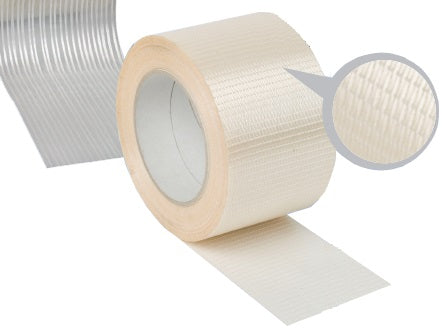
Extra strong tear resistant tape ideal for bundling heavy products and closing and reinforcing boxes. Reinforced with glass fibre filaments.
- Very strong
Tapes / Specialist Tapes / Reinforced
| Order Code | Size W x L | Type | Pack Quantity |
| 13R25M | 25mm x 50m | Mono-weave | 36 |
| 13R50M | 50mm x 50m | Mono-weave | 18 |
| 13R25 | 25mm x 50m | Cross-weave | 36 |
| 13R50 | 50mm x 50m | Cross-weave | 18 |
| 13R75 | 75mm x 50m | Cross-weave | 12 |
Reinforced Filament Tape (Glass Fibre Reinforced) — Overview
Reinforced filament tape is a specialist packaging tape designed for demanding applications where standard carton sealing tape can stretch, split, or tear. It uses embedded glass fibre filaments to deliver high tensile strength and excellent tear resistance, making it suitable for bundling heavy items, reinforcing cartons, and stabilising loads for storage or transport. In this collection you’ll find reinforced tape in mono-weave and cross-weave constructions, supplied in practical roll sizes for warehouse and industrial packing workflows.
Typical uses include closing heavy corrugated boxes, reinforcing seams and edges, securing awkward loads, and bundling long or rigid products such as pipes, profiles, or components. Because the reinforcement carries load through the filaments, this tape is often chosen when a closure must resist sudden shocks, vibration, or handling impacts during distribution.
Reinforced Tape — Helpful Guide
This guide explains the main reinforced tape types in this category and how to match them to your packing task. Reinforced filament tapes are commonly grouped by the direction of the glass fibre reinforcement:
Mono-weave reinforced filament tape (high strength in one direction)
Mono-weave (sometimes described as mono-directional) reinforced tape contains filaments that primarily run along the length of the tape. This construction is especially effective when the main force is pulling lengthwise—such as when strapping, bundling, or holding items together under tension. It is commonly used for unitising products, securing coils, and reinforcing cartons where the stress is concentrated along a seam.
- 13R25M — 25mm x 50m mono-weave reinforced tape for narrow reinforcement lines, smaller bundles, and targeted seam strengthening.
- 13R50M — 50mm x 50m mono-weave reinforced tape for general heavy-duty carton closure and broader reinforcement across seams.
Cross-weave reinforced filament tape (balanced strength in multiple directions)
Cross-weave reinforced tape uses a crisscross filament pattern. This helps resist tearing and splitting in more than one direction and can provide a more balanced reinforcement layer across a carton seam or over a surface. Cross-weave is often selected for heavy carton sealing, export packing, and applications where loads may shift or where impacts could initiate a tear from different angles.
- 13R25 — 25mm x 50m cross-weave reinforced tape for narrow carton reinforcement, banding, and bundling where multi-directional tear resistance is helpful.
- 13R50 — 50mm x 50m cross-weave reinforced tape for heavy carton sealing and reinforcement of seams and edges.
- 13R75 — 75mm x 50m cross-weave reinforced tape for wide-area reinforcement on large or heavy cartons and for strengthening overpacked or high-stress closures.
Where Reinforced Filament Tape Fits in a Packing Process
Reinforced filament tape is typically used as a structural reinforcement rather than a cosmetic seal. In many operations it is applied after the carton is closed to strengthen the main seam, or it is used as the primary closure when the carton is heavy, the contents are dense, or the shipment will experience rough handling. It can also be applied as a band around a box (or around a product) to provide a strap-like holding force without using plastic strapping.
- Carton closure for heavy loads: Helps prevent seam failure on heavy or high-value shipments.
- Edge and corner reinforcement: Adds strength where cartons are most likely to crush or split.
- Bundling and unitising: Holds multiple items together (e.g., tubes, rods, profiles) for easier handling.
- Pallet stabilisation: Can be used to secure cartons or components to a pallet where additional reinforcement is needed.
- Export and long-distance shipping: Useful when cartons face vibration, stacking pressure, and repeated handling.
Case Study: Preventing Carton Seam Failure on Dense Shipments
A warehouse shipping dense, heavy components in double-wall cartons experienced occasional seam splits during transit. Standard packing tape held initially but could stretch under load, especially when cartons were lifted by the base or when stacked. The packing team introduced reinforced filament tape as a seam reinforcement: after closing the carton, they applied a continuous strip along the centre seam and added short cross strips at the ends. The result was a more stable closure that resisted sudden shocks and reduced seam failures during handling and distribution.
Key takeaway: when the failure mode is seam splitting or tearing under tension, reinforcement that carries load through embedded filaments can improve closure reliability.
How to Choose the Correct Reinforced Tape
Selecting the right reinforced filament tape is mainly about matching construction and width to the forces your package will experience. Use the points below as a practical checklist.
1) Choose mono-weave vs cross-weave
- Choose mono-weave when the main stress is lengthwise tension (bundling, unitising, strap-like holding, reinforcing a seam that is being pulled apart).
- Choose cross-weave when you want more balanced tear resistance and reinforcement across multiple directions (heavy carton sealing, export packing, reinforcement over larger areas).
2) Choose the tape width based on contact area and load
- 25mm is useful for narrow reinforcement lines, smaller bundles, and targeted strengthening where space is limited.
- 50mm is a versatile width for heavy carton sealing and general reinforcement across seams.
- 75mm provides wider coverage for large cartons, high-stress closures, and applications where you want reinforcement spread over a bigger area.
3) Consider the application method
For consistent results, apply reinforced tape to clean, dry surfaces and use firm pressure to ensure good contact. When reinforcing cartons, focus on the main seam and high-stress points such as edges and corners. For bundling, wrap with sufficient overlap and keep tension consistent so the filaments carry the load evenly.
4) Plan for handling and transit conditions
Think about how the package will be lifted, stacked, and transported. Dense contents, long transit routes, repeated handling, and vibration can all increase stress on closures. Reinforced filament tape is often chosen when these conditions make standard carton sealing tape unreliable.
Application Tips for Better Performance
- Reinforce the seam, not just the flap: Run tape along the centre seam and extend it down the sides to distribute stress.
- Use cross strips where needed: Short perpendicular strips at the ends of the main seam can help resist peel forces.
- Avoid dusty or damp surfaces: Contamination can reduce adhesion and lead to early lifting.
- Match tape to the job: Use mono-weave for tension-heavy bundling; use cross-weave for broader reinforcement and multi-directional tear resistance.
- Test on your packaging: If you’re changing carton grades or pack weights, trial a few closures and simulate handling to confirm performance.
Common Mistakes to Avoid
- Using narrow tape on very heavy cartons: Too little contact area can concentrate stress and reduce closure reliability.
- Applying tape without pressure: Reinforced tape still needs good surface contact to adhere properly.
- Relying on a single strip for high-risk shipments: For heavy or export packs, seam reinforcement plus end strips can improve security.
- Ignoring the direction of force: Mono-weave excels in lengthwise tension; cross-weave is better when forces vary.
Q&A
What is reinforced filament tape used for in packaging?
Reinforced filament tape is used for heavy-duty tasks such as closing and reinforcing corrugated cartons, bundling long or heavy products, and stabilising loads for transport. Embedded glass fibre filaments provide high tensile strength and tear resistance compared with standard packing tape.
What is the difference between mono-weave and cross-weave reinforced tape?
Mono-weave reinforced tape has filaments mainly running in one direction, giving very high strength along the tape length for bundling and tension loads. Cross-weave uses a crisscross filament pattern, offering more balanced tear resistance and reinforcement across multiple directions.
How do I choose between 25mm, 50mm, and 75mm widths?
Choose 25mm for narrow reinforcement lines and smaller bundles, 50mm for general heavy carton sealing and seam reinforcement, and 75mm for large or heavy cartons needing wider coverage. Wider tape spreads stress over a larger area and can improve closure stability.
Can reinforced filament tape replace plastic strapping?
In some bundling and unitising applications, reinforced filament tape can provide strap-like holding force and may reduce the need for strapping. However, very heavy loads or sharp-edged products may still require strapping or edge protection depending on handling and safety needs.
What application steps help reinforced tape perform reliably?
Apply to clean, dry surfaces and press firmly to ensure full contact. Reinforce the main carton seam and extend tape down the sides to distribute load. For higher-risk shipments, add short cross strips at seam ends to resist peel forces during handling.