

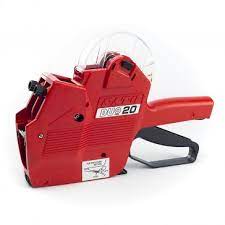
Price Guns
Lynx C-6 Black Price Gun (2612/6) — Quick Overview
The Lynx C-6 Black Price Gun (often referenced as a 2612/6 format gun) is a compact, hand-held, one-line labelling tool designed for fast, consistent price marking on retail products. It prints a single line of characters using a 6-band (6-digit) layout and applies a matching label in one smooth action—ideal for busy shop floors where speed and legibility matter.
This style of pricing gun is widely used for everyday shelf and product pricing, promotional markdowns, and simple coding where a short numeric line is required. Comparable 2612/6-format guns are commonly paired with CT4 26mm x 12mm wavy-edge labels, making it easy to source consumables for ongoing use.
Key Features
One-line, 6-digit print layout:
A straightforward single-line print with six character bands helps produce clear, consistent pricing or numeric codes. This format is commonly used for prices up to typical retail ranges (for example, 99.99 depending on the symbol configuration).
Fast “print-and-apply” operation:
Squeeze the trigger to print and apply the label in one motion—reducing handling time and improving consistency compared with handwriting or separate printing and sticking steps.
Common label compatibility (CT4 26mm x 12mm):
Many 2612/6-format guns use CT4 26x12mm wavy-edge labels, a widely available size across multiple suppliers, helping simplify reordering and stock management.
Replaceable ink roller system:
Like other C-series/2612-style guns, the ink roller is a consumable part. Replacing the roller restores print clarity when impressions become faint or patchy.
Practical for retail environments:
Designed for frequent, repetitive use in shops, storerooms, and stockrooms where quick, readable labels are essential.
- One-line pricing/coding with a 6-band layout
- Hand-held trigger action prints and applies labels quickly
- Common consumables (often CT4 26mm x 12mm labels)
- Replaceable ink roller for ongoing crisp print quality
- Suitable for busy retail workflows such as repricing and promotions
Typical Uses
- Everyday retail pricing on packaged goods
- Promotional pricing and markdown events
- Stockroom repricing and quick relabelling
- Simple numeric coding where a short one-line print is required
Lynx C-6 Black Price Gun — Full Product Guide
Hand labellers in the 2612/6 class are popular because they balance speed, readability, and low running costs. The Lynx C-6 is built around a simple workflow: load a roll of compatible labels, ensure the ink roller is in good condition, and then print-and-apply labels as you move through your pricing tasks. This guide explains how this type of gun is typically used, what to consider when choosing labels and rollers, and how to get the best results in day-to-day retail environments.
How It Works
A one-line price gun uses a set of rotating character bands (in this case, six) to form the printed line. You set each band to the required digit/symbol, then squeeze the handle. The gun inks the selected characters via the ink roller, prints onto the label, and advances the label so it can be applied to the product surface. This single action is what makes pricing guns so efficient for high-volume work.
Because the print is mechanical, consistency is a major advantage: once the bands are set, every label is uniform until you change the settings. This is particularly helpful for promotions, batch repricing, or any scenario where multiple items share the same price.
Materials and Construction
Pricing guns are designed to be lightweight and durable for repeated trigger use. The body is typically a robust plastic housing with internal mechanical components that control band selection, inking, label feed, and application. The “black” designation refers to the gun’s colourway; the functional design is focused on comfortable handling and reliable label advancement.
As with most hand labellers, the consumables—labels and ink rollers—are the key to performance. Using the correct label size and a fresh roller helps maintain clean, readable prints and smooth feeding.
Label Size and Compatibility
Comparable 2612/6-format guns are commonly associated with CT4 26mm x 12mm wavy-edge labels. This is a widely stocked label format, often available in different adhesives (such as removable/peelable, permanent, or freezer-grade) depending on your application.
Why label compatibility matters:
If the label roll is the wrong size or core format, you may experience misfeeds, skewed printing, or poor application. Sticking to the commonly specified 26x12mm CT4 format for this class of gun helps ensure reliable operation and makes reordering straightforward.
Ink Roller Guidance
Print clarity depends heavily on the ink roller. When the roller begins to dry out or wear, you may notice faint characters, patchy printing, or inconsistent impressions. Replacing the roller is a quick way to restore crisp output.
For Lynx C-series guns, suppliers often reference a Lynx C ink roller. Some retailers also list cross-compatibility with E4 / Motex 2612-style rollers for equivalent 2612/6-format guns, but compatibility can vary by branding/version—so it’s best to match the roller to the exact gun model you’re using.
Floor Type Compatibility
This product is a hand-held labelling tool rather than a floor-installed system, so “floor compatibility” is not applicable in the way it would be for mats, tapes, or flooring products. Instead, the key compatibility considerations are:
- Label compatibility (commonly CT4 26x12mm for 2612/6-format guns)
- Ink roller compatibility (match to Lynx C-series or the equivalent specified roller)
- Surface compatibility (choose label adhesive appropriate to the product surface and environment)
Health and Safety
Pricing guns are generally straightforward to use, but good practice helps prevent minor issues:
- Keep fingers clear of the label exit and application area during operation.
- Store safely when not in use to avoid accidental trigger pulls and to protect the print mechanism.
- Use appropriate labels for the environment (for example, freezer-grade adhesive for cold storage) to reduce label lift and rework.
- Replace rollers when print quality drops to avoid repeated overprinting or wasted labels.
Ideal Applications and Use Cases
The Lynx C-6 / 2612/6 format is best suited to environments where staff need to label quickly and consistently:
- Retail shops: rapid pricing for new stock, promotions, and markdowns.
- Convenience stores: frequent price changes and clear, legible labels.
- Stockrooms and back-of-house: batch repricing and inventory labelling workflows.
- Market stalls and pop-ups: portable, no-power-needed pricing solution.
If you regularly label many items at once, a mechanical price gun can significantly reduce time spent compared with handwriting, while improving consistency and readability for customers.
Maintenance, Cleaning and Care
Routine care helps keep feeding smooth and printing sharp:
- Replace the ink roller when prints become faint or uneven.
- Use compatible labels to reduce jams and skewed prints.
- Keep the mechanism clean by removing dust or adhesive residue around the label path (avoid harsh solvents unless recommended by the manufacturer).
- Store in a dry place to help prevent roller drying and to protect labels from humidity.
If labels begin to misfeed, the most common causes are an incorrectly loaded roll, an incompatible label format, or debris in the feed path. Reloading the roll carefully and checking label size typically resolves the issue.
Case Study (Typical Retail Scenario)
Scenario: A small retailer runs a weekend promotion and needs to reprice a large number of items quickly.
Approach: Staff set the 6-band layout to the promotional price and work aisle-by-aisle, applying consistent labels in one motion.
Outcome: Pricing is completed faster than handwriting, labels are uniform and easy to read, and the store avoids confusion at the till caused by inconsistent or unclear markings.
This is the kind of high-volume, time-sensitive task where a one-line pricing gun is particularly effective.
Who Is It For?
- Retailers who need a simple, reliable one-line pricing solution
- Teams that do frequent promotions or markdown cycles
- Businesses that want consistent, legible labels without powered printers
- Users who prefer common consumables (widely available label sizes and rollers)
Colours / Features Available
This listing is for the black Lynx C-6 price gun. Pricing guns in this class are often available in different colourways depending on supplier range, but the core function remains the same: one-line printing with a 6-band layout and compatible 26x12mm labels.
Sizes Available
Pricing guns are typically sold as a single hand-held unit rather than in “sizes” like apparel or packaging. The main “options” to consider are:
- Pack quantity (where offered as single units or multi-packs)
- Consumables (label rolls and ink rollers matched to the gun)
- Label adhesive types (removable, permanent, freezer-grade, etc., depending on supplier)
If you’re unsure which labels or roller to order, match the gun to the commonly referenced CT4 26x12mm label format and confirm the correct roller type for the Lynx C-series/your specific model version.