

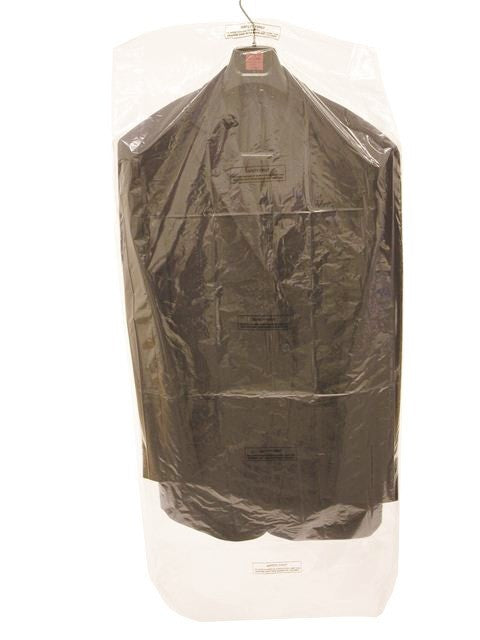
Garment Covers - Shaped
Shaped Garment Covers — Protective Storage & Transit Cover for Hanging Garments
Shaped garment covers are designed to protect hanging garments from dust, handling marks and general soiling during storage, distribution and day-to-day back-of-house use. This product is a shaped cover format intended to follow the outline of a hanging garment more closely than a flat bag, helping reduce excess material around the shoulders and body of the garment while still providing full-length coverage.
These covers are supplied as a bulk pack option and are commonly used anywhere garments need to be kept clean and presentable between processing steps—such as after finishing, steaming, pressing, quality checks, merchandising preparation, or prior to customer collection and delivery.
Key Features
Shaped profile for a neater fit
The shaped format is intended to sit more naturally around garments on hangers, helping provide a tidy presentation and practical protection without unnecessary excess material.
Lightweight protective barrier
A garment cover provides a simple physical barrier against dust and incidental contact, helping garments stay cleaner for longer during storage and handling.
Suitable for hanging storage and workflow
Designed for use on hanging rails and in garment processing environments, supporting efficient movement of items through back-of-house operations.
Bulk supply for operational efficiency
Supplied in a pack quantity suited to regular use, helping maintain consistent availability in busy garment-handling settings.
- Shaped garment cover format for hanging garments
- Protects against dust and handling marks during storage and transit
- Designed for operational use in garment processing and retail environments
- Bulk pack supply to support ongoing workflows
Typical Uses
- Dry cleaning and laundry operations (post-cleaning protection)
- Garment finishing areas (after pressing/steaming)
- Retail stockrooms and merchandising preparation
- Costume departments, wardrobe rooms and uniform issue points
- Alterations and tailoring (protecting finished items awaiting collection)
- Distribution and storage of hanging garments
Shaped Garment Covers — Full Product Guide
Keeping garments clean and presentable is often less about heavy-duty packaging and more about consistent, practical protection at the right points in your workflow. Shaped garment covers are a straightforward solution for protecting hanging garments from dust and incidental contact while they move through processing, storage and delivery stages. This guide explains how shaped garment covers are typically used, what to consider when selecting them, and how to get the best results in day-to-day operations.
How It Works
A shaped garment cover is placed over a garment that is already on a hanger. Once fitted, the cover acts as a protective layer between the garment and its environment. In typical use, the cover helps reduce exposure to dust and airborne particles, and it can also help prevent light scuffing or marks that can occur when garments brush against each other on a rail or during handling.
Because the cover is shaped, it is intended to follow the garment’s outline more closely than a flat cover. This can help keep the cover sitting neatly on the hanger and reduce excess material that might snag or bunch during movement along rails.
Materials and Construction
This listing is for a shaped garment cover specified as 100g. In garment packaging, weight is commonly used as a practical indicator of material substance and handling feel. A heavier weight can feel more substantial in use, while still remaining suitable for routine operational workflows.
As with most garment covers used in professional environments, the construction is intended to be simple and functional: a shaped profile that accommodates hanging garments and supports quick application and removal as items move through your process.
Floor Type Compatibility
Garment covers are typically used in environments where garments are stored or moved on hanging rails. Compatibility is therefore less about floor type and more about how garments are transported and stored:
- Hanging rails and racking: Suitable for garments stored on fixed rails, mobile rails, or racking systems.
- Back-of-house processing areas: Useful where garments are moved between stations (e.g., finishing, QC, packing).
- Vehicle transport with hanging systems: Can be used where garments are transported on hangers to reduce exposure to dust and contact.
If garments are moved through mixed environments (stockroom to shop floor, workshop to customer collection area), a cover can help maintain presentation consistency across each stage.
Health and Safety
In busy garment-handling environments, safe and consistent use matters. Consider the following good practices:
- Keep walkways clear: Avoid allowing excess cover material to trail into aisles or snag on equipment.
- Use appropriate handling: When moving covered garments on rails, maintain spacing to reduce snagging and improve visibility.
- Storage of unused covers: Keep packs stored clean and dry to avoid contamination before use.
Always follow your site’s internal handling procedures, especially where garments are moved near heat sources, pressing equipment, or high-traffic areas.
Ideal Applications and Use Cases
Shaped garment covers are commonly chosen when you want a neat fit and practical protection for hanging garments. Typical applications include:
- Dry cleaners and laundries: Protecting finished garments after cleaning and finishing steps.
- Retail operations: Keeping stock clean in back-of-house storage and during merchandising preparation.
- Uniform management: Protecting issued uniforms or prepared sets awaiting collection.
- Wardrobe and costume departments: Helping keep garments clean between fittings, rehearsals, and storage.
- Tailoring and alterations: Protecting completed items while awaiting pickup or delivery.
Maintenance, Cleaning and Care
Garment covers used in operational settings are typically treated as protective packaging rather than a laundered textile. To maintain performance and presentation:
- Store unused packs properly: Keep in a clean, dry area away from direct contamination.
- Apply covers after finishing: Where possible, cover garments after pressing/steaming and once items are ready for storage or dispatch.
- Replace when needed: If a cover becomes torn, heavily creased, or contaminated, replace it to maintain garment presentation standards.
Case Study (Typical Workflow Example)
Scenario: A garment processing operation handles a steady flow of customer items daily. After cleaning and finishing, garments are placed on a rail for quality checks and then staged for collection or delivery.
Approach: Once each garment passes QC, a shaped garment cover is applied while the item remains on its hanger. Covered garments are then grouped by route or collection time on dedicated rails.
Outcome: The covers help reduce dust exposure and incidental contact between garments, supporting a cleaner presentation at handover and reducing the likelihood of rework due to marks picked up during staging.
Who is it for?
- Dry cleaners, laundries and garment finishing services
- Retailers managing hanging stock in back-of-house areas
- Uniform and workwear issue departments
- Wardrobe, costume and theatre departments
- Tailors and alteration services
- Any operation needing practical protection for hanging garments
Colours / Features Available
This product page may represent a configurable range. Where multiple options are available, select the variant that matches your operational needs. If you require a specific feature set for your workflow, check the variant details shown on the page.
Sizes Available
This listing is presented as a shaped garment cover product with size options shown as variants. Please select the required option from the available variants on the product page. If you need guidance on choosing a suitable cover size for your garments and hanger type, consider the garment length and shoulder profile you typically handle, and allow enough clearance for easy application and removal.