

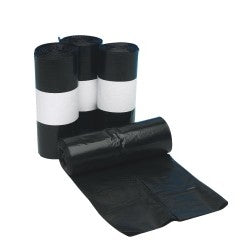
Refuse-On-Roll
Overview
MAMMOTH Refuse-On-Roll sacks are designed for everyday waste handling where a dependable, easy-dispense roll format is preferred. Supplied on a roll for quick access and tidy storage, these refuse sacks are suited to routine bin-lining and general waste collection in workplaces, facilities, and busy domestic settings.
Key Features (at a glance)
- Roll format for convenience – easy to store, dispense, and issue to staff.
- Consistent sack specification – manufactured to a defined gauge/weight for predictable performance.
- General-purpose refuse handling – ideal for day-to-day waste streams where a robust liner is required.
- Simple replenishment – rolls make stock control straightforward for cleaners, caretakers, and facilities teams.
- Suitable for multiple environments – useful across commercial, public-sector, and household applications.
Typical Uses
- Office and workplace waste bins
- Schools, colleges, and community buildings
- Light industrial and workshop waste (non-sharp, non-hazardous)
- Hospitality back-of-house waste collection
- Domestic general refuse and clear-outs
MAMMOTH Refuse-On-Roll Sacks — Full Product Guide
Choosing the right refuse sack is about balancing convenience, strength, and suitability for the waste you handle every day. This MAMMOTH Refuse-On-Roll product is supplied in a roll format to keep sacks compact, easy to dispense, and simple to distribute across multiple rooms or teams. The specification is intended to provide reliable performance for general refuse collection without overcomplicating ordering or storage.
How It Works
Refuse-on-roll sacks are supplied as a continuous roll of individual sacks. This format helps keep your cleaning cupboard or stores organised and makes it easy to tear off a single sack when needed. In practice, teams can carry a roll on a trolley, keep one in a cupboard on each floor, or issue rolls to staff so replacements are always close at hand.
For best results, fit the sack neatly into the bin so the base sits fully in the bottom and the top edge can be folded over the rim. This improves stability, reduces the chance of the sack slipping into the bin, and helps prevent over-stretching at the top when the bin is full.
Materials and Construction
These sacks are produced to a defined weight/gauge specification (as shown in the product title). That specification is a practical indicator of the sack’s intended duty level and helps you select a liner that matches your waste type and handling routine. A consistent specification supports predictable performance across repeat orders, which is especially important for facilities teams managing multiple sites.
As with most refuse sacks, performance depends not only on the material but also on how the sack is used: the shape of the bin, the type of waste, and whether the sack is dragged, lifted, or carried all influence real-world durability.
Duty Level and Performance Guidance
This product is designed for general refuse collection where a robust liner is required. To get the best performance:
- Avoid sharp edges – broken glass, sharp metal, and jagged plastics can puncture most liners. Where sharp waste is unavoidable, use appropriate specialist sacks or rigid containers.
- Don’t overfill – overfilling increases stress at the rim and seams and makes safe lifting harder.
- Lift rather than drag – dragging sacks across rough floors can cause abrasion and tearing.
- Match sack size to bin – a correctly sized liner reduces stretching and improves stability.
Floor Type Compatibility
Because these are bin liners and refuse sacks, they are compatible with all floor types in normal use. However, handling practices matter. If sacks are routinely dragged across rough concrete, textured safety flooring, or outdoor surfaces, abrasion risk increases. In those environments, consider using lifting techniques, sack holders, or trolleys to reduce contact with abrasive surfaces.
Health and Safety
Good waste-handling practice protects staff and reduces incidents:
- Manual handling – keep loads manageable and use correct lifting technique. If sacks are heavy, use a trolley or split waste into multiple sacks.
- Contamination control – segregate waste streams appropriately and follow site rules for food waste, clinical waste, or hazardous materials.
- PPE – gloves are recommended when handling refuse sacks, especially in shared or public environments.
- Spill prevention – ensure sacks are seated properly in bins and tied/closed before moving.
Ideal Applications and Use Cases
Facilities management
Roll format makes it easy to issue sacks to cleaning teams and keep replenishment points stocked. Suitable for routine bin changes in corridors, washrooms, kitchens (general waste), and shared spaces.
Hospitality and catering (general waste)
Useful for back-of-house waste where frequent bin changes are required. Keep rolls near waste stations for quick turnaround during busy periods.
Education and public buildings
A practical choice for caretakers and cleaning contractors who need consistent liners across multiple rooms and buildings.
Workshops and light industrial
Suitable for non-sharp general waste. If your waste includes sharp offcuts or heavy, angular items, consider a more specialised solution.
Maintenance, Cleaning and Care
Refuse sacks are single-use consumables, but you can improve day-to-day outcomes with a few simple habits:
- Store rolls clean and dry – keep away from excessive heat and direct sunlight to maintain material condition.
- Use a bin with a smooth rim – rough or damaged rims can snag liners.
- Use sack holders where appropriate – holders reduce slippage and help prevent tearing at the top edge.
- Close sacks before transport – tying or sealing reduces spills and odours.
Case Study (Typical Scenario)
A small facilities team managing a multi-room workplace often needs a liner that is quick to dispense and consistent across repeat orders. By keeping a roll on each cleaning trolley and a spare roll in key cupboards, staff can replace liners immediately without returning to a central store. The roll format reduces loose packaging waste and helps keep storage areas tidy, while the defined sack specification supports predictable performance for routine general refuse.
Who is it for?
- Cleaning teams and contract cleaners
- Facilities managers and caretakers
- Offices, schools, and public buildings
- Hospitality venues needing frequent bin changes
- Households wanting a convenient roll format for general waste
Colours / Features Available
This listing represents a refuse-on-roll product line that may be offered in different pack formats/variants. Please select the variant that matches your preferred pack quantity and any available options shown on the page.
Sizes Available
This product page may include multiple variants. Choose the option that best matches your bin and waste volume requirements. If you are unsure which size is most suitable, consider measuring your bin (rim circumference and height) and selecting a liner that fits comfortably without excessive stretching.
Need help choosing?
If you can share your bin type and typical waste (light office waste, mixed general waste, etc.), we can help you select the most suitable refuse-on-roll option from the variants available on this page.