

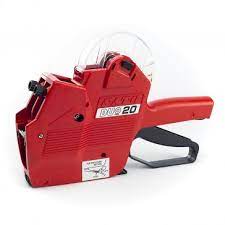
Price Guns
Lynx C-17A Alpha/Numeric Price Gun — Overview
The Lynx C-17A is a robust, hand-held, two-line alpha/numeric price gun designed for fast, consistent ticketing on retail shelves and stock. It’s built for everyday use where you need clear, repeatable print on self-adhesive labels—helping teams price, code and identify products quickly without relying on pre-printed tickets.
This model is commonly referenced as a Lynx C-A17 / C-17A format and is widely described as a two-line gun that prints 10 alphanumeric characters on the top line and 7 numeric characters on the bottom line, typically onto 26×16 mm labels (often referred to as CT7 label format). It uses a compatible Lynx C ink roller for clean, legible impressions.
Key Features
- Two-line alpha/numeric printing: Create clearer tickets by separating information across two lines—commonly described as 10 alpha/numeric characters on the top line and 7 numeric characters on the bottom line.
- Designed for 26×16 mm labels: A popular label size that balances readability with compact placement on packaging and product surfaces.
- Fast, repeatable ticketing: Ideal for high-throughput pricing and coding where consistency matters.
- Uses Lynx C ink rollers: Replaceable ink rollers help maintain crisp print quality over time.
- Retail-ready versatility: Suitable for pricing, date/batch coding, department codes, promotions, and internal stock identifiers (depending on how you set the bands).
Typical Uses
- Retail shelf and product pricing
- Stockroom identification and internal coding
- Promotional pricing and short-term markdowns
- Department, aisle, or category codes
- Batch/lot references and traceability-style identifiers (where appropriate)
Lynx C-17A Alpha/Numeric Price Gun — Full Product Guide
Choosing the right price gun is about more than just printing a number. In busy retail and warehouse environments, you need a tool that’s quick to operate, produces consistent results, and supports the kind of information your team actually uses day-to-day. The Lynx C-17A format is popular because it combines two-line printing with alpha/numeric capability, giving you more flexibility than a single-line numeric gun.
Below is a practical guide to what this style of gun is used for, how it typically works, and what to consider when selecting labels and ink rollers.
How It Works
A hand-held price gun prints by transferring ink from an ink roller onto a label as you squeeze the trigger. The print bands (also called wheels or bands) are set manually to the characters you want to display. When you apply pressure via the trigger, the gun advances the label, prints the selected characters, and presents the next label ready for the next application.
With a two-line alpha/numeric gun like the Lynx C-17A format, you can split information across two lines. Many sellers describe this configuration as 10 alpha/numeric characters on the top line and 7 numeric characters on the bottom line. This layout is useful when you want a clear separation between, for example, a code and a price, or a department identifier and a batch reference.
Materials and Construction
Price guns are designed to be handled repeatedly throughout the day. A good unit should feel stable in the hand, with a trigger action that supports repetitive use. While exact construction details can vary by production run and supplier bundle, the Lynx C-17A format is generally positioned as a durable, everyday retail tool.
Because print quality depends heavily on the ink roller condition and correct label compatibility, ongoing performance is typically maintained by using the correct roller type (commonly referenced as a Lynx C ink roller) and the correct label size/format.
Label Format and Print Layout
This model is commonly associated with 26×16 mm labels (often referenced as CT7). That size is widely used because it provides enough space for two lines of information while still fitting neatly on many product surfaces.
When selecting labels, match the gun’s required label dimensions and core/roll format. Using the wrong label size can cause feeding issues, misalignment, or poor print placement. If you’re unsure which labels you currently use, check the label box or measure an existing label (width × height) and compare it to the gun’s stated compatibility.
Floor Type Compatibility
This section is not applicable to this product. The Lynx C-17A is a hand-held labelling tool and does not interact with floor surfaces.
Health and Safety
For safe, comfortable use in busy environments:
- Repetitive use: Encourage operators to take short breaks during long ticketing runs and to alternate hands where practical.
- Keep fingers clear: Avoid placing fingers near the label exit and print head area while operating the trigger.
- Use correct consumables: Correct labels and ink rollers reduce jams and misfeeds, which can otherwise lead to forced operation and potential strain.
- Storage: Store the gun in a clean, dry place to help protect the ink roller and keep dust away from the feed path.
Ideal Applications and Use Cases
A two-line alpha/numeric gun is especially useful when you need more than a simple price. Common real-world setups include:
- Code + price: Put an internal code or department identifier on the top line and the selling price on the bottom line.
- Promotion messaging: Use the top line for a short promo cue (where your character set allows) and the bottom line for the price.
- Stock identification: Use alpha/numeric characters to create short stock references that are easier to interpret than long numeric strings.
- Batch/lot references: Where your process requires it, use the two lines to separate batch references from other identifiers.
If your operation only ever prints a simple price, a single-line numeric gun may be sufficient. If you regularly need a code plus a price (or two distinct pieces of information), the Lynx C-17A format is a practical step up.
Maintenance, Cleaning and Care
Keeping a price gun working smoothly is mostly about routine checks and timely consumable replacement:
- Replace the ink roller when print fades: If characters become light or patchy, fit a fresh compatible roller (commonly referenced as a Lynx C ink roller).
- Keep the label path clean: Dust and adhesive residue can build up over time. Wipe accessible areas gently with a dry cloth. Avoid harsh solvents unless you’re following manufacturer guidance.
- Use labels that feed cleanly: Poor-quality or incorrect labels can cause jams and inconsistent printing.
- Check alignment: If print drifts or sits too high/low, confirm you’re using the correct label size and that the roll is seated properly.
Case Study (Typical Scenario)
Scenario: A convenience retailer needs to price incoming stock quickly while also marking a short internal code for staff reference.
Approach: Staff set the top line to an internal identifier (e.g., department or supplier code) and the bottom line to the selling price. Using a two-line alpha/numeric layout helps keep tickets consistent across the store and reduces confusion at the shelf edge.
Outcome: Faster ticketing during deliveries, clearer shelf labels, and fewer pricing queries because the printed information is structured and repeatable.
Who Is It For?
- Retailers who need two-line printing for clearer shelf-edge communication
- Teams that benefit from alpha/numeric coding (not just numeric prices)
- Stockrooms and warehouses that want quick, consistent identification labels
- Businesses running frequent promotions or markdown cycles
Colours / Features Available
Product pages for configurable listings may include multiple options. Availability can vary by supplier bundle and current stock. If your listing includes selectable options, choose the variant that matches your preferred configuration.
Sizes Available
This is a hand-held price gun rather than a cut-to-size product. The key “size” consideration is the label size compatibility. This model is commonly described as using 26×16 mm labels (CT7 format). If you also need labels and ink rollers, ensure you select the correct compatible consumables for this gun.
Need help matching labels or ink rollers?
If you’re replacing an existing gun or restocking consumables, check your current label dimensions and roller type. Matching the correct label format (commonly 26×16 mm for this model) and the correct ink roller (commonly Lynx C) is the best way to ensure smooth feeding and crisp print.