

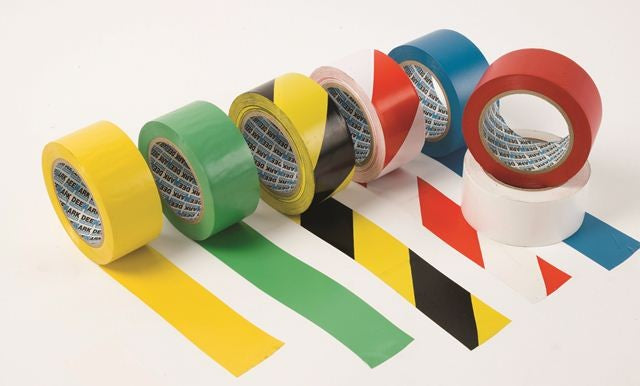
Line Marking - Hazard Tape
High-visibility hazard line marking tape designed to help you clearly define safe routes, restricted areas and caution zones in busy workplaces. This yellow & black striped floor marking tape is a quick, clean alternative to paint for creating clear visual guidance on floors and other smooth surfaces.
Whether you’re organising pedestrian walkways in a warehouse, marking out storage bays, highlighting trip hazards, or creating temporary exclusion zones during maintenance, hazard tape provides an immediate, universally recognised warning pattern that supports safer movement and better site organisation.
Key Features
High-visibility hazard stripes:
The yellow and black pattern is widely used for warning and hazard identification, helping areas stand out at a glance in industrial and commercial environments.
Fast, paint-free application:
Apply directly to a clean, dry surface to create crisp lines without drying time, fumes, or specialist equipment—ideal when you need to mark areas quickly.
Helps improve workplace organisation:
Use it to define walkways, keep-out zones, staging areas, and equipment locations, supporting 5S and lean workplace layouts.
Strong adhesion on suitable surfaces:
Designed to stick securely to compatible smooth floors and surfaces when properly prepared (cleaned, dry, and free from dust/grease).
Easy to cut and position:
Can be trimmed to length for straight runs, corners, and boxed areas. Great for creating clear boundaries around machinery, pillars, doors, and loading areas.
Versatile for many sites:
Commonly used in warehouses, factories, workshops, schools, hospitals, retail back-of-house areas, and distribution centres.
- High-visibility yellow & black hazard stripe design
- Quick to apply—no drying time like paint
- Ideal for safety zoning, walkways and hazard identification
- Supports tidy, clearly defined work areas
- Cut-to-length for flexible layouts
Typical Uses
- Marking hazardous areas near machinery, pinch points, or low headroom zones
- Defining pedestrian walkways and crossing points
- Highlighting edges, steps, ramps, and changes in floor level
- Creating temporary caution zones during cleaning or maintenance
- Outlining storage bays, pallet positions, and staging areas
- Guiding traffic flow in warehouses and distribution centres
Yellow & Black Line Marking Tape — Full Product Guide
Clear floor marking is one of the simplest ways to improve safety and efficiency. Hazard stripe tape is used when you want a strong visual warning that draws attention to a boundary or risk area. It’s especially useful where you need a neat finish quickly, or where painting is impractical due to downtime, ventilation, or surface restrictions.
How It Works
This product is a pressure-sensitive adhesive tape. Once applied to a properly prepared surface, it bonds to the floor and provides a bold, contrasting hazard stripe that is easy to see from standing height and at distance. Because it’s tape-based, you can create straight lines, boxed zones, and directional layouts with minimal disruption.
Best practice for clean lines:
Measure and mark your layout first, then apply the tape in steady runs. For corners and boxed areas, cut cleanly with a sharp blade and press down firmly along the edges to reduce the chance of lifting.
Materials and Construction
Hazard line marking tapes are typically manufactured from durable plastic film with a printed stripe pattern and a strong adhesive backing. The film provides the visible warning surface, while the adhesive layer is designed to hold on compatible smooth floors when applied correctly.
What this means in practice:
You get a consistent, high-contrast stripe pattern and a tidy finish that looks professional in safety-critical areas. As with all adhesive tapes, performance depends heavily on surface preparation and the condition of the floor.
Floor Type Compatibility
Line marking tape generally performs best on smooth, sealed, and non-porous surfaces. Typical suitable surfaces include sealed concrete, smooth epoxy-coated floors, vinyl, and other clean, flat industrial flooring.
Important:
If your floor is dusty, porous, rough, or contaminated with oil/grease, adhesion can be reduced. For best results, thoroughly clean and dry the area before application and test a small section if you’re unsure.
Health and Safety
Hazard stripe tape is a visual safety aid and should be used as part of a wider safety system (signage, training, and safe working procedures). Ensure the tape is applied flat with no raised edges to reduce trip risk. In high-traffic areas, regularly inspect the tape and replace sections that show wear or lifting.
- Apply to clean, dry surfaces to reduce lifting
- Press down edges firmly—especially at joins and corners
- Inspect routinely in busy areas and replace worn sections
- Use alongside appropriate safety signage and procedures
Ideal Applications and Use Cases
This tape is commonly used anywhere you need a clear warning boundary without the permanence of paint. It’s particularly useful for:
- Warehouses & distribution: marking hazard zones near racking ends, loading bays, and forklift operating areas
- Factories & workshops: highlighting machine perimeters, maintenance zones, and restricted access areas
- Facilities management: temporary caution marking during repairs, refits, or cleaning schedules
- Back-of-house retail: defining delivery areas, stock zones, and staff-only routes
Maintenance, Cleaning and Care
To help the tape last longer, keep the surface clean and avoid aggressive scraping at the edges. Routine sweeping and standard floor cleaning methods are usually suitable, but always avoid harsh solvents unless you have tested them on a small area first.
Tips to extend service life:
- Allow the adhesive to bond—avoid heavy traffic immediately after application where possible
- Use a roller or firm pressure to ensure full contact with the floor
- Replace small worn sections promptly to keep markings clear and professional
Case Study (Example Layout)
Scenario: A busy warehouse wants to reduce near-misses at a packing area where pedestrians and pallet trucks cross paths.
Approach: Hazard stripe tape is used to outline a caution zone around the packing benches and to highlight the crossing point. Additional plain line marking tape (where used) defines the pedestrian walkway leading to the area.
Outcome: The hazard boundary makes the risk area obvious, encourages slower movement through the crossing, and helps keep the packing zone clear of stored pallets.
Who is it for?
- Health & safety teams improving visual management
- Warehouse managers implementing clearer traffic routes
- Facilities teams needing quick, low-disruption marking
- Maintenance teams creating temporary caution zones
- Any workplace using 5S/lean organisation methods
Colours / Features Available
This listing is for the classic yellow & black hazard stripe pattern used for warning and caution marking. If you are planning a full site layout, you may also use other line marking colours (where available) to separate walkways, storage, and operational zones.
Sizes Available
This product is supplied as a roll of line marking tape. As this page may represent multiple variants, select the option you need from the product choices shown on the page.
Need help choosing?
If you’re unsure which tape is best for your floor type or traffic level, share a quick description of your surface (e.g., sealed concrete, epoxy, vinyl) and the expected traffic (foot traffic, pallet trucks, forklifts), and we can help you select the most suitable option.