

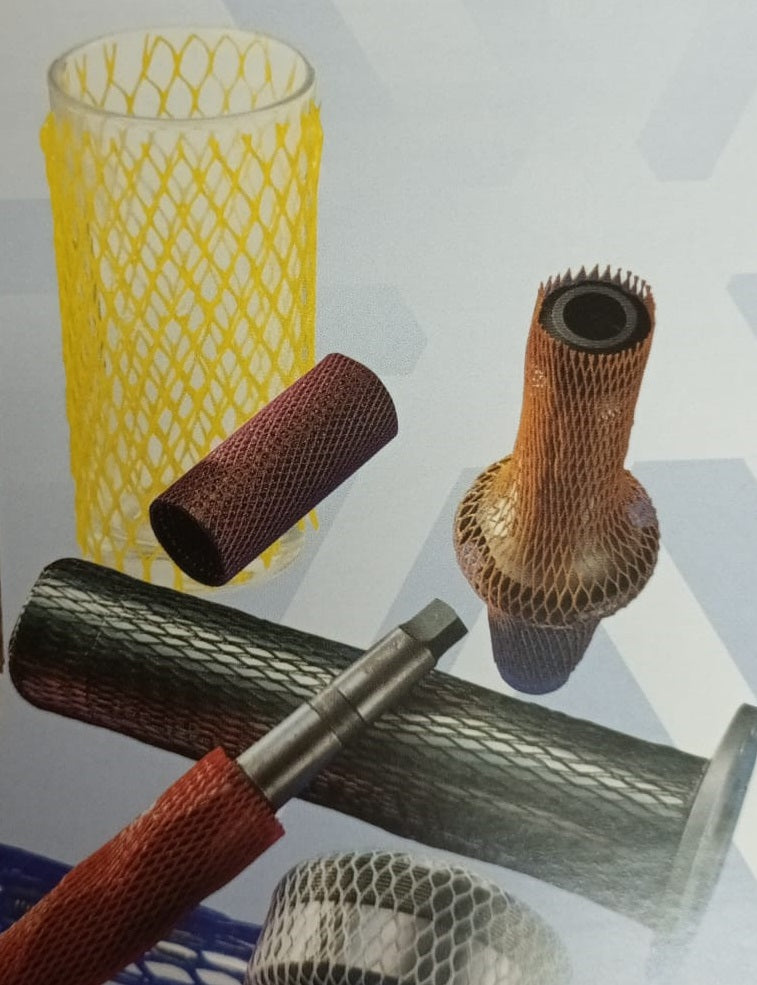
Foam Rolls
Yellow Protective Mesh Sleeving (Expandable Protective Netting) — Product Overview
Protective mesh sleeving is a lightweight, flexible net designed to shield products from scuffs, scratches and minor knocks during handling, storage and transit. This yellow protective mesh sleeving is supplied on a roll and is intended to expand to suit a range of item diameters, making it a practical choice when you need one protective solution for multiple product sizes. The open mesh structure allows airflow and visibility of the item underneath, while still creating a cushioning barrier between surfaces.
Commonly used across manufacturing, warehousing and fulfilment operations, mesh sleeving is quick to apply: simply cut to length and slide over the item. It is especially useful for protecting finished surfaces such as painted, polished or plated components, as well as fragile edges and corners that can be marked when items rub together.
What you’re buying: a roll of yellow protective mesh sleeving with an expandable diameter range (often referenced as 40–60mm) and a roll length of 50m. (Avoid selecting protection purely by nominal size—choose based on the outside diameter of the item you want to cover and the level of protection required.)
Key Features
Expandable fit:
Designed to stretch over a range of diameters, helping one roll cover multiple product sizes and reducing the need to stock many different protective formats.
Scratch and scuff protection:
Creates a protective barrier between items and surrounding packaging, helping reduce cosmetic damage caused by rubbing, vibration and contact during transit.
Breathable open mesh:
The net-like structure allows airflow and drainage, which can be beneficial for items that must not be sealed in an airtight wrap.
Fast application:
Cut to length and slide on—ideal for packing benches and production lines where speed and consistency matter.
Lightweight and space-efficient:
Supplied on a roll for easy dispensing and compact storage compared with bulky foam profiles or rigid protectors.
Colour-coded identification:
Yellow is commonly used as a size identifier in protective sleeving ranges, helping teams quickly pick the correct option on the packing line.
- Expandable protective mesh sleeving supplied on a roll
- Yellow colour for quick identification
- Helps protect surfaces from scuffs and scratches
- Open mesh structure for airflow and visibility
- Cut-to-length for minimal waste
Typical Uses
- Protecting finished components during internal handling and storage
- Separating items in cartons to reduce rubbing and transit marks
- Covering edges, rims and protrusions that are prone to scuffing
- Protecting parts prior to secondary packaging (boxes, crates, pallets)
- General-purpose surface protection for warehouse picking and dispatch
Yellow Protective Mesh Sleeving — Full Product Guide
Choosing the right protective sleeving is about matching the sleeving’s expandable range to your product’s outside diameter and selecting a protection method that suits your packing process. The guidance below explains how mesh sleeving works, where it performs best, and how to get consistent results in day-to-day use.
How It Works
Protective mesh sleeving is manufactured as a tubular net. When relaxed, the tube has a smaller diameter; when you push an item into it, the mesh expands and conforms around the surface. This creates a resilient buffer that helps prevent direct contact between the item and other surfaces (other products, carton walls, straps, or pallet wrap). Because the structure is open, it does not behave like a sealed film—air can pass through and the item remains visible for identification.
In practice, operators typically cut a section from the roll, then slide it over the product. For longer items, the sleeving can be applied from one end and worked along the length. For short components, pre-cut lengths can be prepared in advance to speed up packing.
Materials and Construction
Mesh sleeving is a flexible polymer netting formed into a continuous tube. The construction is designed to balance stretch, recovery and abrasion resistance. The open lattice provides cushioning by distributing contact points across the surface rather than allowing broad face-to-face rubbing. This makes it particularly suitable for protecting cosmetic finishes where minor scuffs would be unacceptable.
Because the sleeving is supplied on a roll, it is easy to dispense and store. Many operations keep rolls at packing stations with a simple cutter or safety knife to produce consistent lengths.
Choosing the Right Fit (Diameter Range)
Mesh sleeving is typically specified by an expandable diameter range. To select the correct option:
- Measure the outside diameter of the item at its widest point (including any flanges, collars or protective caps).
- Choose a sleeving range that comfortably expands to that diameter without excessive stretching.
- Consider surface sensitivity: highly polished or coated items may benefit from a slightly looser fit to reduce friction during application.
If your product varies in diameter along its length, select based on the largest section. For irregular shapes, test a short sample length to confirm ease of application and the level of protection.
Floor Type Compatibility (Packing Environment)
While mesh sleeving is not a floor product, it is often used in environments where dust, debris and handling conditions can affect packing quality. In busy warehouses, the open mesh can pick up loose particles if stored uncovered. For best results:
- Store rolls in a clean, dry area near the packing line.
- Keep the roll end tidy to prevent snagging and to maintain consistent dispensing.
- Use a dedicated cutting tool to avoid frayed ends and to improve presentation.
Health and Safety
Protective mesh sleeving is straightforward to use, but good packing practice helps reduce risk:
- Cutting: Use a safety knife or guarded cutter where possible. Cut away from the body and keep hands clear of the blade path.
- Manual handling: For long or heavy items, apply sleeving on a bench or with two-person handling to avoid strain.
- Snag hazards: The mesh can catch on sharp edges. If your product has burrs or sharp corners, consider deburring or using an additional edge protector before sleeving.
Ideal Applications and Use Cases
This type of protective sleeving is commonly used for:
- Manufactured components: protecting cosmetic finishes on parts during storage and transport between workstations.
- Fulfilment and distribution: separating items in cartons to reduce rub marks and transit abrasion.
- Engineering and maintenance: protecting replacement parts and assemblies during dispatch.
- General warehousing: quick protection for items that are handled frequently or stacked closely.
It is particularly effective when the main risk is surface marking from contact rather than heavy impact. For high-impact protection, mesh sleeving can be combined with outer packaging such as corrugated cartons, foam, or void fill.
Maintenance, Cleaning and Care
Mesh sleeving is typically used as a consumable protective packaging material. To keep it performing well:
- Keep rolls dry and away from direct heat sources.
- Prevent contamination from oils, adhesives or dust that could transfer to sensitive surfaces.
- Replace rolls that become snagged, heavily soiled or difficult to dispense cleanly.
If you are using sleeving for internal reuse (for example, between production stages), inspect it regularly for tears or embedded debris that could scratch the product.
Case Study (Typical Packing Workflow)
Scenario: A warehouse dispatches finished components with cosmetic surfaces that must arrive mark-free. Items are picked into totes, then packed into cartons for courier shipment.
Approach: Operators cut mesh sleeving to a standard length, slide it over each component, then place the protected items into cartons with minimal additional void fill. The sleeving prevents surface-to-surface rubbing and reduces the need for individual wrapping.
Result: Faster packing, improved presentation on arrival, and fewer returns due to cosmetic scuffs—while keeping packaging weight low.
Who Is It For?
- Packing teams who need a fast, repeatable protection method
- Manufacturers protecting finished surfaces between processes
- Distributors shipping items where cosmetic condition matters
- Operations looking to reduce packaging waste by using cut-to-length protection
Colours / Features Available
Protective mesh sleeving ranges are often colour-coded to help identify different diameter ranges quickly. This product is supplied in yellow, making it easy to distinguish at the packing bench and helping reduce selection errors when multiple sizes are stocked.
Sizes Available
This listing represents a protective mesh sleeving option supplied on a roll. Mesh sleeving is commonly offered in multiple expandable diameter ranges and roll lengths. If you need a different diameter range, colour, or roll length for your application, select the appropriate option from the product range or contact us for guidance on choosing the best fit.
Need help selecting the right sleeving?
Tell us the outside diameter of your item (at the widest point), the item length, and whether the surface is particularly sensitive. We can help you choose the most suitable expandable range and packing method.