

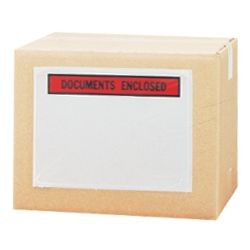
"Document Enclosed" Envelopes
C5 “Document Enclosed” Envelopes (Documents Enclosed Wallets) — Overview
C5 “Document Enclosed” envelopes are a simple, highly visible way to include paperwork with outgoing mail and parcels. Marked clearly with “DOCUMENTS ENCLOSED”, they help recipients and carriers spot important paperwork quickly, reducing the chance that invoices, delivery notes, packing slips or return documents are overlooked during handling.
This product page may represent multiple pack quantities/variants of the same C5 “Document Enclosed” envelope. The core purpose remains the same: to keep essential documents together and easy to identify in transit and on arrival.
Key Features
Clear “DOCUMENTS ENCLOSED” identification:
The bold message on the face of the envelope makes enclosed paperwork easy to find at the point of delivery, in goods-in departments, and during internal distribution.
C5 format for common paperwork:
C5 is a widely used envelope size (commonly used for A5 sheets or A4 folded once), making it a practical choice for everyday dispatch documentation.
Helps streamline receiving and processing:
By separating and highlighting paperwork, these envelopes can support faster checking-in of deliveries, invoice matching, and proof-of-delivery workflows.
Professional presentation:
A dedicated “Document Enclosed” envelope gives shipments a tidy, consistent look—useful for businesses that send regular orders or formal correspondence.
Versatile across industries:
Suitable for warehouses, e-commerce fulfilment, manufacturing dispatch, offices, healthcare administration, education, and any environment where paperwork must travel with goods.
Key Features (Bullet Summary)
- Printed “DOCUMENTS ENCLOSED” for instant visibility
- C5 envelope format suited to common document sizes
- Supports efficient goods-in processing and document control
- Professional, consistent dispatch presentation
- Ideal for parcels and mail where paperwork must be easy to locate
Typical Uses
- Invoices and statements sent with orders
- Packing slips and delivery notes
- Returns paperwork and RMA documentation
- Customs or export documentation (where applicable)
- Service reports, job sheets, and installation paperwork
- Internal mail distribution where documents must be prioritised
C5 “Document Enclosed” Envelopes — Full Product Guide
Including paperwork with shipments sounds straightforward, but in busy dispatch and receiving environments documents can be misplaced, separated from the goods, or simply missed. A clearly marked “Document Enclosed” envelope helps solve that problem by making the paperwork obvious and easy to retrieve. Below is a practical guide to choosing, using, and getting the best results from C5 “Document Enclosed” envelopes.
How It Works
The concept is simple: place the relevant paperwork inside the envelope and ensure it is presented in a way that is easy to spot. The printed “DOCUMENTS ENCLOSED” message acts as a visual cue for anyone handling the item—drivers, warehouse teams, reception staff, and end recipients—so the documents are found quickly and processed correctly.
In many operations, the paperwork is as important as the goods themselves. Delivery notes confirm what was shipped, invoices support payment processing, and returns forms enable fast resolution. Using a dedicated “Document Enclosed” envelope helps keep these documents together and reduces the risk of delays caused by missing paperwork.
Materials and Construction
“Document Enclosed” envelopes are typically made from paper suitable for mailing and handling. The key functional element is the clear printed message on the front. Because this listing may cover multiple variants, the exact paper weight, closure type, and finish can vary by option; however, the intended use remains consistent: secure containment of documents and clear identification.
If your workflow involves frequent handling (multiple touchpoints from packing bench to courier to goods-in), consider how the envelope will be treated: will it be stacked, sorted, or handled outdoors? Choosing a robust envelope option can help maintain legibility and keep documents protected through the journey.
Floor Type Compatibility (Operational Fit)
While “floor type compatibility” is usually discussed for mats and flooring products, the equivalent consideration here is operational compatibility—how well the envelope fits into your dispatch and receiving process:
- Warehouse and fulfilment lines: easy to integrate into pick/pack stations where paperwork is printed and inserted as part of the packing step.
- Office mailrooms: supports sorting and prioritisation of important documents.
- Goods-in departments: helps receiving teams locate delivery notes quickly for checking and booking-in.
- Multi-site operations: improves consistency across locations by standardising how paperwork is presented.
In short, these envelopes are most effective when they become a standard step in your packing checklist.
Health and Safety
Good document control can support safer, more compliant operations. Clear paperwork presentation can reduce time spent searching through packaging, which in turn can reduce unnecessary handling and congestion at goods-in desks. For environments with strict documentation requirements (for example, regulated goods, controlled processes, or audited supply chains), ensuring paperwork is clearly enclosed and easy to retrieve can help maintain orderly procedures.
As with all packaging materials, store envelopes in a clean, dry area to keep them in good condition and to maintain print clarity.
Ideal Applications and Use Cases
E-commerce and parcel fulfilment:
When shipping high volumes, small inefficiencies add up. A “Document Enclosed” envelope helps ensure packing slips and returns information are consistently included and easy for customers to find.
Manufacturing and trade dispatch:
Trade customers often require delivery notes and job references to book goods in. A clearly marked envelope helps the receiving team locate the paperwork immediately.
Wholesale and distribution:
For palletised or multi-carton shipments, paperwork can be separated from the goods. Using a dedicated envelope supports consistent documentation across consignments.
Professional services and field operations:
Service reports, certificates, and job sheets can be enclosed with equipment or returned parts, helping maintain traceability.
Education, healthcare, and administration:
Where documents must be handled carefully and routed correctly, clear identification supports smoother internal processing.
Maintenance, Cleaning and Care
Paper envelopes require minimal maintenance, but good storage and handling practices help preserve usability:
- Keep dry: store away from moisture to prevent warping and to keep the printed message crisp and readable.
- Avoid crushing: store flat to prevent creasing that could affect presentation.
- Use a consistent packing step: standardise where the envelope is placed so staff and recipients know where to look.
If you are using these envelopes as part of a documented packing process, consider adding a quick check step (e.g., “paperwork inserted and visible”) to reduce errors.
Case Study (Typical Workflow Example)
Scenario: A small fulfilment team ships daily orders to business customers. Previously, delivery notes were sometimes placed loose inside cartons, leading to delays when customers’ goods-in teams couldn’t find the paperwork quickly.
Change: The team standardised on C5 “Document Enclosed” envelopes for all outbound shipments. Packing slips and invoices were inserted into the envelope as part of the final packing step.
Outcome: Customers reported faster booking-in and fewer queries about missing paperwork. Internally, the fulfilment team reduced rework caused by forgotten documents and improved consistency across shifts.
This is a representative example of how “Document Enclosed” envelopes are commonly used to improve document visibility and reduce avoidable admin.
Who Is It For?
- Warehouses and fulfilment centres that need consistent paperwork inclusion
- E-commerce sellers shipping parcels daily
- Manufacturers and trade suppliers sending delivery notes with goods
- Office administrators managing outgoing mail and internal routing
- Operations teams aiming to reduce disputes and improve traceability
Colours / Features Available
This listing is for C5 envelopes printed with “DOCUMENTS ENCLOSED”. Depending on the variant selected on the page, pack quantities and other configuration options may differ. If you require a specific presentation style for your process (for example, a particular closure type or finish), select the appropriate option from the available variants.
Sizes Available
This product is presented in a C5 envelope format. As product pages can represent multiple variants, please refer to the options on the page for the available pack quantities and any other selectable features.
Ordering Tips
- Match the envelope to your paperwork: if you commonly include multi-page documents, ensure your chosen option suits the thickness you typically send.
- Standardise placement: decide where the envelope should be positioned on your parcel/mail item so it is always easy to find.
- Train for consistency: a simple checklist step can significantly reduce missing-document errors.
Frequently Asked Questions
What does “Document Enclosed” mean?
It indicates that important paperwork is included with the shipment or mail item, helping handlers and recipients locate it quickly.
What is C5 used for?
C5 is a common envelope size used for everyday documents, often suitable for A5 sheets or A4 folded once. (Always confirm your specific document format and folding requirements.)
Are these suitable for parcels as well as letters?
They are commonly used wherever paperwork needs to travel with an item—both in postal mail and in parcel dispatch workflows.
Need help choosing the right option?
If you’re unsure which variant best fits your packing process, share what documents you include (e.g., number of pages, typical paper size, and whether you send letters or parcels) and we can help you select the most suitable configuration.